Based on our drawstring bag product specs and the cord safety points kept from the earlier article.
A buyer forwarded a competitor's quote last spring with one line highlighted: toddler drawstring bag, unit price, delivery in 30 days. She asked whether the number was real. The sheet had four lines on it. A bag that goes to a two year old carries costs that never appear on a four line quote, and those costs do not disappear when the sheet is short. They move to the buyer, the inspector, or the claim file.
The Quote Line That Looks Cheapest

The competitor's sheet listed fabric, printing, cord, and packing. Each line had a number and the total sat below them. Nothing on the page described what the cord would do under a pull, or who would sign the paperwork that lets the bag enter a European or American market.
That shape of quote is common because it is easy to compare. A buyer can put three suppliers side by side and pick the lowest total in an afternoon. The comparison works only if all three suppliers left out the same things. When one supplier quietly includes a breakaway closure and another does not, the cheaper number is not a cheaper bag. It is a smaller bag.
The first job with any toddler quote is to find out which costs were moved off the page. Four of them matter most: closure hardware, fabric and lining, compliance paperwork, and the rework that arrives after delivery.
Cord and Closure: The First Cost You Cannot See
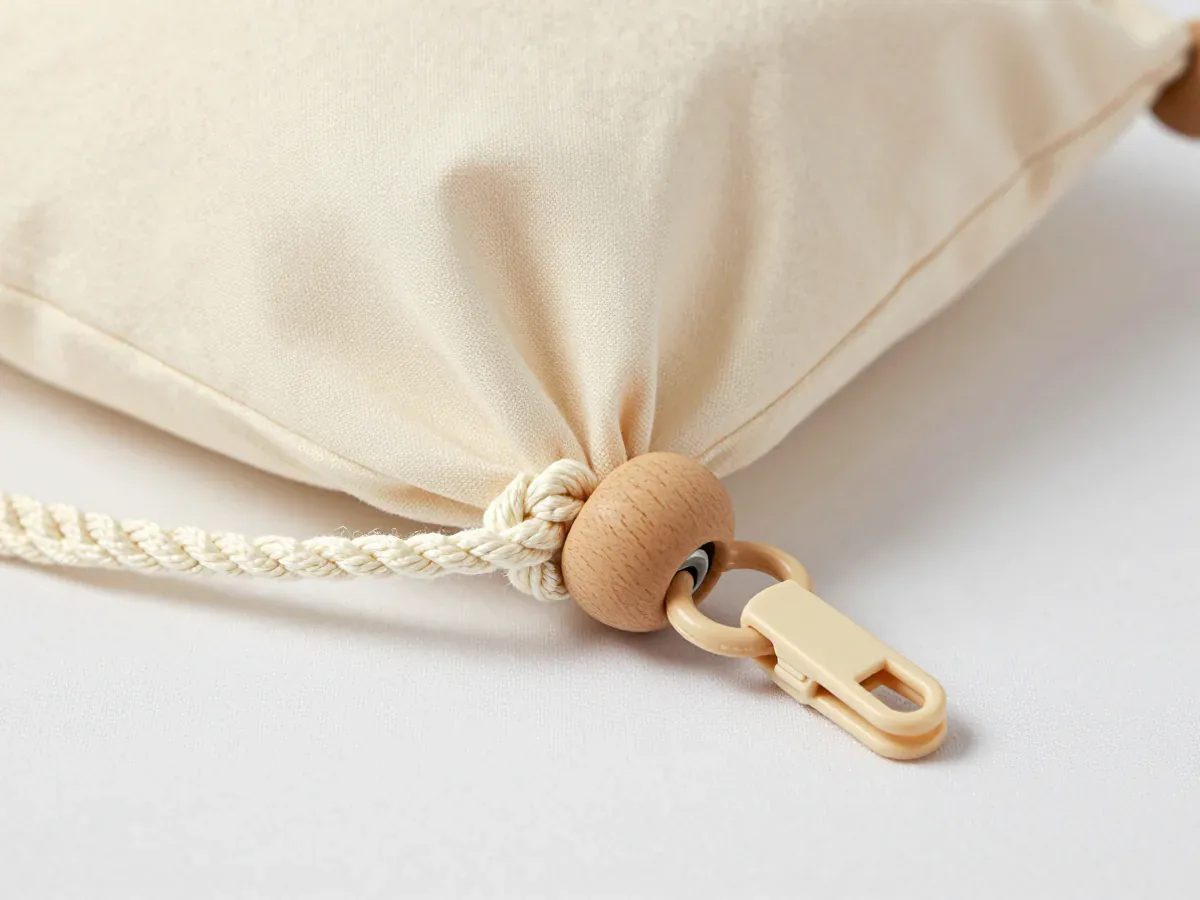
On a standard drawstring bag the cord is a few cents of braided polyester and a plastic stopper. On a toddler bag the same cord has to release, shorten, or anchor in a way that keeps it away from a small neck. That change touches the cord, the channel it runs through, and the hardware at the end.
A fixed cord with a plastic stopper is the cheapest build. A braided drawstring running through a precision stitched channel costs more because the stitching has to hold under load and the channel has to be sized so the cord moves without catching. Wooden toggles and metal grommets add hardware cost and add a small inspection step at each bag.
Breakaway hardware is the line most often missing. It requires a specific component, a tested release force, and a worker who fits it the same way on every bag. The component cost is modest. The cost of setting up the station, training the operator, and checking release force on a sample basis is what pushes the unit price up. A supplier who leaves breakaway off the quote is not offering a discount on the same bag. They are offering a different bag.
Fabric and Lining: Softness Has a Price
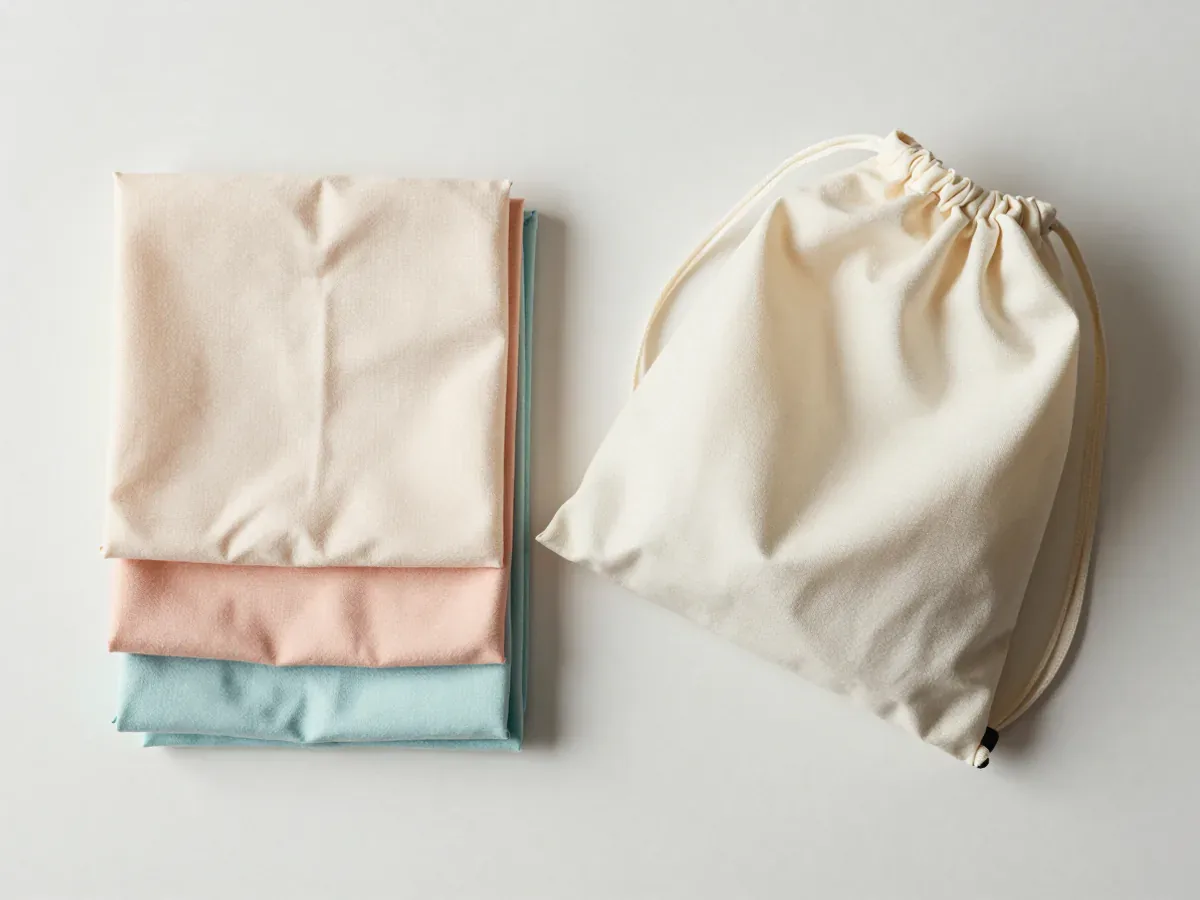
Toddler skin reacts to coarse weave and to dye that has not been rinsed properly. Cotton is the usual answer because it is soft and breathable. rPET canvas is the other common choice, and it carries a story that some retail buyers want on the hangtag.
Both cost more than a basic polyester shell. Cotton needs a heavier yarn to reach the same strength, and rPET canvas needs clean feedstock to keep the surface smooth. A bag that closes with black drawstrings and opens to a light lining uses two fabrics, which means two cutting runs and a lining seam that has to sit flat against a small hand.
The hidden cost here is not the fabric itself. It is the weight. A toddler bag that feels substantial to an adult can be too heavy for an 18 month old to carry. Dropping to a lighter fabric saves money on the quote and creates a bag that sags, stretches at the cord channel, and comes back as a complaint. The right move is to specify a fabric weight and a lining, then let the supplier price that build rather than price a lighter one and call it close enough.
Compliance Paperwork: What EN 14682 and CPSC Add to the Unit Cost

EN 14682 is the European standard that addresses cords and drawstrings on children's clothing, including bags and accessories. It sets limits on cord length and on how cords are attached, with the aim of reducing strangulation risk. The CPSC takes a similar position for the US market and treats cords, straps, and drawstrings as potential strangulation hazards.
Neither standard is a sticker a supplier buys once. Compliance means the bag is designed to the limit, the cord length is controlled in production, and the supplier can show the buyer what was checked. That work has a cost per style, and a smaller cost per unit when the run is large.
A quote that says "meets EN 14682" without a document behind it has moved the paperwork cost to the buyer. The buyer then pays for a lab test, or pays a consultant to review the design, or discovers at customs that the file is incomplete. On a toddler bag the paperwork is not optional decoration. It is part of what makes the bag sellable in the market the buyer is targeting.
Rework and Claim: The Cost That Arrives After Delivery
The cheapest quote usually assumes nothing goes wrong. Cords arrive at the right length, the breakaway component releases in the specified range, the print sits where the artwork said, and the cartons match the packing list. When one of those slips, the cost lands somewhere.
If the supplier catches it, the cost is rework: unpicking channels, refitting hardware, reprinting panels, and re inspecting the run. That cost is real and it is usually absorbed into the next quote, which is why a supplier who reworks often is not actually cheap over a year. If the supplier does not catch it, the cost moves to the buyer: a delayed launch, a discount to the retailer, or a recall.
A claim on a toddler bag is expensive out of proportion to the unit price because the volume is small and the scrutiny is high. A retailer who finds a long cord on one bag will inspect the whole carton and may pull the style. The claim cost is not the replacement bag. It is the shelf space, the freight, and the time spent explaining the problem to a buyer who trusted the original quote.
How to Compare Two Toddler Bag Quotes Line by Line

Put the two sheets side by side and read them in a fixed order. The order matters more than the totals.
Start with the closure. Ask each supplier to name the cord type, the cord length, the hardware at the end, and whether the cord releases under load. A supplier who cannot answer in writing has not priced the feature.
Move to fabric and lining. Ask for the fabric weight, the fibre, and whether the lining is a separate cut. A quote that lists one fabric line for a bag with a lining is missing a cost, and it will appear later.
Then ask for the compliance file. A supplier who works with European or US retail accounts will have a document set for cords and drawstrings. Ask what the file contains and which standard it references. Do not accept a sentence on the quote as the file.
Finally, ask what happens after delivery. Ask how the supplier handles a cord length deviation found at inspection, and who pays for the rework. The answer tells you whether the low number on the sheet is a price or a starting point.
What to Put on the Specification Before You Approve
The specification is where the missing costs get pinned down. Write the cord length as a number with a tolerance, not as "short." Write the closure type as a component with a release behaviour, not as "breakaway." Write the fabric weight and the lining as separate lines so the supplier cannot merge them into one price.
Add a line for the compliance document and name the standard the file should reference. Add a line for the inspection point where cord length is checked, and say whether it is checked on every bag or on a sample. Add a line for what happens when a deviation is found, including who covers the rework.
A toddler drawstring bag can be safe when the cord is short, the closure releases, and the design stays inside the limits that EN 14682 and the CPSC describe. The quote does not have to show every one of those costs, but the buyer should know where each one sits. A cheap sheet is not a warning by itself. A cheap sheet with no closure detail, no fabric weight, and no compliance file is a list of costs that will arrive later, and the buyer will be the one paying them.
FAQ
Are drawstring bags safe for toddlers if the cord is short?
A short cord lowers the risk but does not remove it. The cord still has to be attached so it cannot form a loop around the neck, and the closure should release or stay fixed in a way that matches the standard for the market. Length alone is one variable among several.
Does a breakaway cord cost more than a fixed cord?
The component costs more and the assembly station costs more to set up and check. On a large run the per unit difference is modest. On a small run it can be visible, which is why some quotes leave it out and some buyers never see the line.
What size drawstring bag fits a toddler?
Small bags in the 10 to 12 inch range suit snacks, toys, and a change of clothes. Medium bags around 14 to 16 inches are better for daycare or school essentials. The bag should stay light enough for the child to carry without strain.
Do toddler drawstring bags need EN 14682 testing?
EN 14682 addresses cords and drawstrings on children's clothing and accessories, and it is the reference most European buyers ask for. Whether a specific bag needs a test depends on the market and the retailer. The design should be built to the limit either way, and the supplier should be able to show what was checked.