

A cost breakdown drawn from our bag branding specs and the wear points that decide rework.
A complaint landed on a buyer's desk in March about a canvas tote that "felt cheap" after six weeks of daily use. The bag was intact, the seams were sound, and the print was still legible, so the buyer sent photos and asked the factory to explain what had gone wrong. The reply pointed at the branding, not the bag: the woven label at the seam had curled at one corner and the thread had faded unevenly against the canvas.
That answer cost the buyer a refund, a replacement run and a week of emails. None of those costs appeared on the original quote, which had listed branding as a single line with a single number. Three suppliers had quoted the same tote that month, and the branding lines read differently on each sheet, which is where the real comparison should have started.
Three quotes on the table, three different numbers

The first sheet priced embroidery at a rate per thousand stitches and left the backing and stabiliser out. The second priced a woven label per piece and buried the sewing labour inside a general “labour” line. The third quoted a patch as a separate item and added an attachment charge that only appeared in the small print.
Read side by side, the three numbers looked comparable. Read line by line, they described three different products. One quote assumed the logo would be stitched straight into the bag face, one assumed a label sewn at the seam, and one assumed a patch bonded to the front panel. Each method carries its own material, its own labour step and its own failure mode, and a quote that folds all of that into one figure hides the part that decides the final cost.
A buyer comparing these sheets needs the same three questions answered for each: what exactly is being attached, how is it attached, and what happens at the end of the bag’s life when the branding is the first thing to go.
The line item nobody prices: attachment
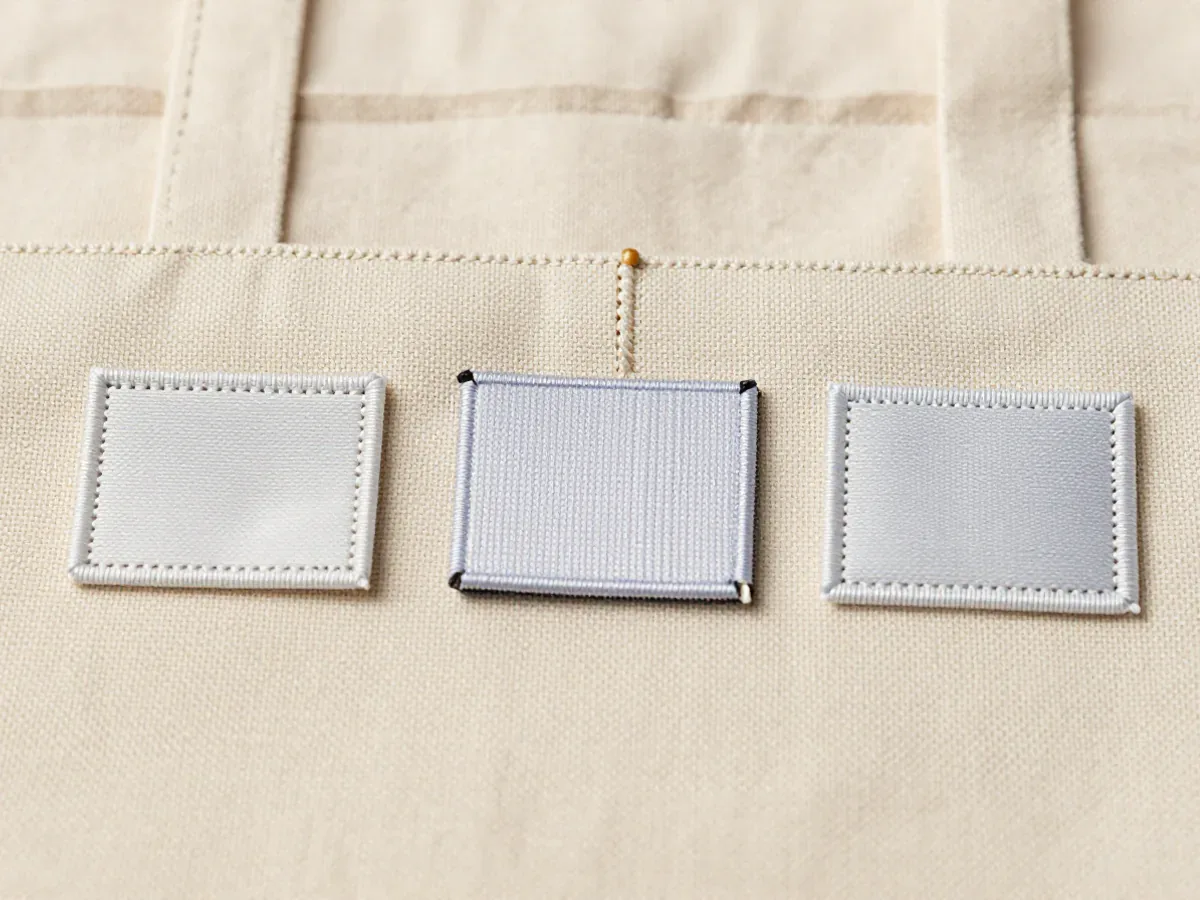
Embroidery stitches the logo directly into the bag fabric, so there is no separate part to come loose. That single fact removes an entire cost category from the quote, because there is no label edge to finish, no adhesive to cure and no corner to lift. The trade is that the stitching goes into the bag face itself, so a poor stitch shows on the inside as well as the outside.
A woven label is woven separately and then sewn or heat sealed onto the bag. The label carries fine detail and multiple colours well, but it introduces a join between two materials, and that join is where most label failures begin. A patch sits between the two: it is produced as its own piece with a stitched edge, then attached by sewing or bonding, which adds a step that has to be specified and inspected.
The attachment step rarely appears as its own line on a quote. It shows up later as a rework charge, a replacement run or a claim, and by then the unit price comparison is meaningless. A buyer who asks for the attachment method in writing before the quote is final gets a number that can actually be compared with the next supplier’s.
Where colour fastness turns into a claim

Branding has to survive washing, rubbing and light, and those are separate tests from the strength of the attachment. A label can be sewn on perfectly and still fail because the thread loses colour after a few washes, or because the dyed ground fabric bleeds into a pale logo.
Colour fastness to washing, to rubbing and to light are standard textile tests, and a supplier should be able to name the method used for each. The number that matters is not a single pass mark but the gap between the branding and the bag fabric: if the logo fades faster than the canvas, the bag looks worn out while the body is still serviceable.
This is where a cheap quote turns expensive. A buyer who accepts a branding line without a fastness check is accepting a claim risk that will surface months after the goods are paid for. The cost of that claim includes the refund, the freight on replacements and the time spent proving which party is responsible, and none of it was visible on the quote.
Rework cost when a patch corner lifts

A patch itself can be very durable, but it is only as good as its attachment. A peeling or lifting corner is the usual failure, and it tends to appear after the bag has been in use for a few weeks, which is exactly when a retail customer notices it.
Rework on a lifting patch is rarely a simple repair. The bag has to be returned, the old adhesive or stitching removed without damaging the face, and a new patch applied, and the labour for that is higher than the original attachment step. If the failure rate is high enough, the whole run becomes a replacement order, and the replacement carries the same attachment risk unless the method changes.
The hidden cost here is not the patch. It is the decision about how the patch is fixed, made once at sampling and then repeated across thousands of units. A buyer who specifies the attachment method and inspects it at the first checkpoint avoids paying for that decision twice.
Adding the lines back up for a canvas tote
Take a heavy canvas tote that will be dragged, loaded and washed. Direct embroidery usually lasts longest on that kind of fabric because it is stitched into the bag rather than joined to it, so the quote should be read with the wear pattern in mind, not just the unit price.
A retail bag that a customer keeps for years should carry embroidery or a finished woven label, and the label needs its edge finished to match the embroidery’s durability. A promotional bag that lives for one season can carry a printed patch and save cost, because the failure horizon is shorter than the claim window.
The arithmetic that matters is total cost across the bag’s expected life: unit price plus the probability of a claim times the cost of that claim, plus the rework labour if a corner lifts. A quote that looks ten percent higher at the unit level can be the cheaper order once the attachment and fastness lines are priced in.
What to write on the spec sheet before the quote

The spec sheet is where the hidden costs are either closed or left open. A branding line that names the method, the attachment, the thread or label colour and the fastness test gives every supplier the same target, and the quotes that come back can be compared without guesswork.
Our own bag specs name one of three branding routes: screen print, a woven label or retail packing, and each route carries its own attachment and inspection points. Quality control runs four checkpoints before a bag is packed, and the branding check belongs at the point where the attachment is made, not at final packing.
A buyer preparing a spec sheet should write the branding method, the attachment method, the colour reference for thread or label, the fastness tests required and the inspection point where the attachment is checked. Decide the branding method from how the bag will be used, not from the logo alone: embroidery for hard wear, a woven label for fine detail, a patch for artwork that cannot be stitched, and a colour and wash test to prove the choice.
FAQ
Is embroidery always more expensive than a woven label?
No. Embroidery removes the separate part and its attachment step, so on a hard-wearing bag the total cost can be lower even when the stitching rate looks higher. The comparison only holds when both quotes price the attachment and the fastness check.
Does a patch cost less if the artwork cannot be stitched?
A patch is the route for artwork that cannot be stitched cleanly, and it is produced as its own piece with a stitched edge. The saving depends on the attachment method, because a bonded patch that lifts will cost more in rework than a sewn one.
How do I compare quotes that list branding differently?
Ask each supplier to break the branding line into material, attachment and inspection, then compare the three parts separately. A quote that will not break out the attachment step cannot be compared with one that does.