

This comparison draws on retail packing specs and label placement rules from bag production files.
A carton of retail bags sat on the inspection table with two barcode options taped to the same panel: one printed into the artwork during the run, one applied as a label after finishing. The buyer had quoted both, and the two prices differed by a few cents per bag, which was not the number that mattered. What mattered was what happened to each code between the factory door and the store shelf, and the quote said nothing about that.
The same split shows up in the paperwork. One spec sheet lists the barcode as part of the artwork file, with a reserved flat area and a quiet zone. The other lists it as a line item in the packing section, with a substrate, an adhesive and an application step. Both are legitimate ways to get a scannable code onto a retail bag. The decision comes down to four things: where the code sits, what it has to survive, what happens when the data changes, and how the code gets checked before the cartons seal.
Two Ways a Barcode Reaches a Retail Bag

Retail bags carry barcodes two ways: printed into the artwork, or applied as labels over printed bodies. Printing integrates cleanly and survives everything the bag survives, but it locks the code into the print run, so a price or SKU change means a print change. Labels give flexibility for mixed-SKU cartons and price updates, at the cost of an application step and an adhesive specification.
The printed route treats the barcode as part of the design. The artwork file has to be structured so the label zone is a reserved flat area, not an afterthought over a seam. Once the plate or screen is made, the code is fixed for that run, and any change means new artwork, new approval and new production time.
The applied route treats the barcode as a packing operation. The bag body prints as normal, and the code arrives later on a label with its own facestock, adhesive and print method. That separation is what buys flexibility, and it is also where the extra specification work lives.
Where the Code Sits and Whether the Scanner Cares
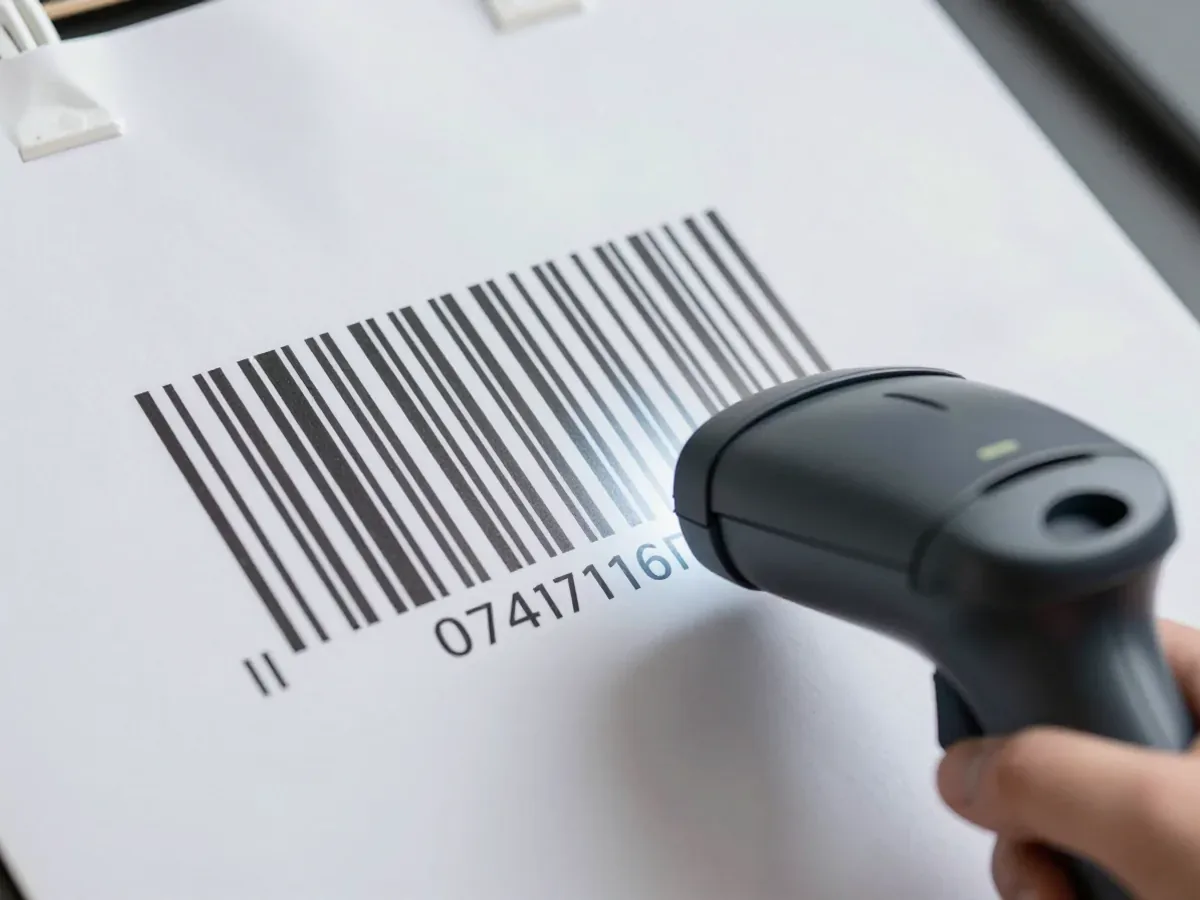
Scanners read contrast and geometry, not intention. A code printed beautifully on a curved surface or across a gusset fold will fail at the till for reasons that have nothing to do with print quality. Gusset folds distort the code geometry and scanners fail on the fold line. Reserve the flattest panel for the code and keep the quiet zone clear.
The quiet zone is the clear space on both sides of the barcode, typically a multiple of the narrowest bar width, with no print, seam or gusset fold inside the zone. As a working rule, 10 times the narrowest bar width on each side of the code, per GS1 conventions; the exact figure follows the code type and size. A printed code and an applied label both have to respect that space. The difference is who controls it.
With printing, the quiet zone is designed into the artwork and confirmed on the proof. With labels, the quiet zone is a physical area on the bag that the label must not cross, and the applicator has to place the label inside it every time. Placement is a scannability specification with measurable rules, and it belongs in the order either way. The global barcode and placement standards are published by GS1, the standards organization behind retail barcodes, and distribution centers enforce them with hardware, not goodwill.
Codes also need to sit within standard scanner sweep heights and be repeated on at least 2 faces of the package so either orientation works. A printed code can be repeated in the artwork at no extra material cost. An applied label repeated on two faces means two labels per bag, which changes the packing line and the label count.
What the Code Has to Survive Between Factory and Shelf

A bag label faces 3 handling stresses that would destroy a paper sticker: abrasion in transit, moisture, and fold cycles, plus washing for reusable bags. A printed code faces the same stresses, but it is part of the surface rather than sitting on top of it, so it does not peel, lift at an edge or trap moisture under an adhesive.
That advantage is real but not absolute. Print quality still has to hold contrast through handling, and a printed code on a bag that flexes repeatedly can wear at the bars if the ink system is wrong for the substrate. The difference is that print failures tend to be gradual, while label failures tend to be sudden: an edge lifts, a label shifts, a code lands half on a seam.
For labels, substrate and print method belong in the spec. Thermal transfer over direct thermal for anything expected to last, synthetic facestock where moisture is expected, and adhesive rated for the bag material, because adhesives that bond to cardboard fail on polypropylene. Direct thermal print fades with heat and abrasion, which is why distribution-center labels that must survive shelving use transfer printing.
Reusable bags raise the bar on both routes. Washing and abrasion requirements rise, so the label substrate and print method move to transfer-printed synthetic labels or woven-in coding. A printed code on a reusable bag has to survive the same wash cycles as the bag itself, which puts the ink and the substrate under the same scrutiny as the fabric.
When a Price or SKU Change Arrives After the Print Run

The change scenario is where the two routes separate most sharply. A printed code is fixed once the run starts. If a price changes or a SKU is added after the plates are made, the options are to reprint, to overprint, or to sticker over the printed code, and each of those carries its own cost and its own scannability risk.
An applied label absorbs change by design. Mixed-SKU cartons can carry different labels from the same bag body, and a price update becomes a label update rather than a print update. That is the flexibility the label route sells, and it is worth paying for when the order profile is volatile.
The cost of that flexibility shows up in the packing step. Labels have to be applied, counted and checked, and the adhesive has to be right for the bag material. A label that lifts in transit turns a price update into a rejected pallet, which is the failure the whole specification exists to prevent.
For orders with a stable code and a single SKU, the printed route removes an entire operation from the packing line. For orders with per-store cartons, multiple listings or frequent price changes, the applied route keeps the bag body common and moves the variability to the label. Retail packing on our orders is set as per-store cartons with barcode labels and shelf-ready polybags, which is one reason the label route shows up often on mixed retail programs.
Which Option Fits Your Order Profile
The printed route fits orders where the code is stable for the life of the run, the bag body is a single SKU, and the panel geometry gives a flat area large enough for the code and its quiet zones. It also fits when the bag surface is difficult for adhesives, since there is no adhesive to specify.
The applied route fits orders with mixed-SKU cartons, per-store packing, frequent price updates, or a bag body shared across several listings. It also fits when the code has to be added after the bag is finished, for example when the retail data arrives late in the program.
Reusable bags sit in a third position. The durability requirement pushes toward transfer-printed synthetic labels or woven-in coding, and the wash cycle makes the adhesive specification more demanding than on a single-use bag. A printed code can work on a reusable bag, but the ink and substrate have to be chosen for washing from the start.
A Side by Side Decision Table
| Dimension | Printed into artwork | Applied as label |
|---|---|---|
| Placement control | Designed into the proof, fixed at plate making | Set by applicator, must stay inside the quiet zone |
| Quiet zone | Part of the artwork file | Physical area the label must not cross |
| Durability | Part of the bag surface, no peel or lift | Depends on facestock, adhesive and print method |
| Change after run | Reprint, overprint or sticker over | New label, same bag body |
| Mixed-SKU cartons | Requires separate print runs | Handled by label variation |
| Extra packing step | None | Application, counting and checking |
| Reusable bag fit | Needs wash-rated ink and substrate | Transfer-printed synthetic or woven-in coding |
| Verification | Scan test at first article | Scan test at first article plus label placement check |
What to Write Into the Bag Spec Either Way
Four lines keep scannability contractual. Line 1: code type and size per GS1 conventions, named per SKU. Line 2: placement, panel, position, orientation and quiet zones, shown on the artwork proof. Line 3: durability, substrate, print method and a rub or wash requirement for reusable bags. Line 4: verification, a scan test at first article.
Those four lines work for both routes, with one adjustment. On the printed route, line 3 describes the ink and the bag surface. On the applied route, line 3 describes the facestock, the adhesive and the print method, and the spec should name the bag material the adhesive has to bond to.
The packing section carries the rest. Polybag, retail or per-store packing is agreed before production, and carton marks are set per store, per listing or per pallet. A print or woven label is approved before the run starts, which applies to the bag label as much as to the brand label. When the barcode is applied, the label approval and the artwork approval are two separate gates, and both need to close before production.
How to Check the Code Before the Cartons Seal

The first article is where the code gets proved. A scan test at first article confirms that the code reads on the actual bag surface, in the actual position, with the actual quiet zone. On the printed route, this is the moment to catch a code that landed too close to a seam. On the applied route, it is the moment to catch a label that sits outside its reserved area or lifts at an edge.
Finished bags are checked by hand for dimensions, handles and logo, and the barcode check belongs in the same pass. Every order passes four QC checkpoints, and the code check should be written into the one that covers finishing and packing, not left to the final carton count.
Cartons are counted and photographed before the container seals. That photograph is the last cheap chance to catch a placement problem, because a code that fails at the distribution center is a pallet rejection, and a code that fails at checkout is a slow line. Neither shows up in the quote, and both are decided long before the cartons close.
FAQ
Can a barcode be printed directly on a gusset fold?
No. Gusset folds distort the code geometry and scanners fail on the fold line. Reserve the flattest panel for the code and keep the quiet zone clear.
Do reusable bags need a different barcode specification?
Yes, on durability. Washing and abrasion requirements rise, so the label substrate and print method move to transfer-printed synthetic labels or woven-in coding.
Is direct thermal printing acceptable for bag labels?
Thermal transfer for anything long-lived. Direct thermal print fades with heat and abrasion, which is why distribution-center labels that must survive shelving use transfer printing.
How wide should the quiet zone be around a barcode?
As a working rule, 10 times the narrowest bar width on each side of the code, per GS1 conventions. The exact figure follows the code type and size.