Notes from a factory floor walk-through of a custom printed tote run, compared with the stock bag route at each station.
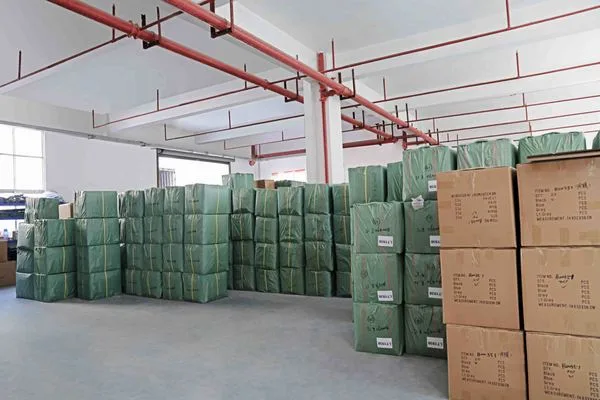
The carton label on the loading bay said 38 by 16.5 in, and the polybag inside said 40 by 44. Nobody caught it until the buyer's agent ran a tape along the fold. That mismatch is where this audit begins, because a custom printed tote and a stock bag can share a purchase order number and still travel two different routes through the same factory.
The order in question was a mixed one: a retail brand had booked a custom canvas run for its spring launch and, as a fallback, a small stock top-up in case the artwork approval slipped. Watching both move down the line made the differences visible station by station, and it also showed which checks matter at each stop.
The order lands and the spec sheet sets the route

The spec sheet is the first place the two bags part company. A stock bag line reads like a short list: shell, handle, size, colour from the available range. A custom line carries the same fields plus a proof reference, a Pantone chip, a woven label position and a note that the sample was made to the same spec as bulk.
That last note matters more than it looks. Printing is proofed before the run, and the sample is built to the bulk specification rather than to a rough approximation. When the merchandiser signed the custom sheet, she was signing a route that would be checked against a physical chip at the press, not against a screen.
The stock sheet had no chip. Its colour line simply named a shade from the supplier's range, with the understanding that stock colours can be swapped for a Pantone match if the buyer asks early enough. That single sentence is the hinge on which the rest of the audit turns.
What to check at this station: confirm that the custom sheet names a proof number and a chip, and that the stock sheet states whether a Pantone swap was requested before the material was booked.
At incoming material, the shell and handle tell different stories

The material bay is where the two orders stop looking alike. The custom tote's shell arrived as cotton canvas in a natural or dyed colour, rolled and tagged by dye lot. The stock bag's shell came in as a finished, pre-made body, already sewn and folded, waiting only for a print or a label.
Handles diverged in the same way. The custom order carried woven, webbing or rope handle stock, cut to length on site. The stock bag arrived with its handles already attached, which means any weakness in the attachment was decided before the goods ever reached this factory.
A dye lot tag on canvas is not decoration. Two rolls from different lots can read the same on a swatch card and still sit apart on a finished bag, and the custom route is the only one where the buyer has a chance to compare lots before cutting begins.
What to check at this station: match the canvas dye lot against the approved sample, confirm the handle type named on the sheet, and note whether the stock bag's handles were attached at origin.
At cutting, the base and fold line decide how the bag sits

Cutting is quick for both bags and revealing for different reasons. The custom tote is cut from flat canvas, so the base and the fold line are created here. A reinforced base and a flat-folding body are built at this table, not added later.
The stock bag skips most of this. Its body was cut and sewn elsewhere, so the cutting station only handles the label or the print placement. That is efficient, and it also means the base of a stock bag is whatever the upstream factory decided, with no chance to adjust.
The fold line is the quiet detail. A body that folds flat needs the fold to land on a straight grain, and a base that carries weight needs its reinforcement aligned with the seam that will close it. On the custom run, the cutter can be corrected mid-batch. On the stock run, there is nothing to correct.
What to check at this station: lay a cut panel flat and watch whether it folds on its own line, then inspect the base reinforcement before the panel moves to sewing.
At printing, the proof and the Pantone chip meet the mesh

The print station is where the custom order earns its extra steps. Screen print and heat transfer are both available routes, and the choice is fixed on the sheet before the mesh is stretched. The press operator works against the approved proof and the physical chip under daylight, not against a monitor.
The stock bag usually arrives with its print already applied, or receives a simple one-colour mark. There is no chip to match because there was no colour commitment in the first place. The shade is whatever the upstream run produced.
This is the station where a buyer's reference photo stops being useful. A logo that looks correct on a phone can sit muddy on canvas, and the only reliable comparison is the chip against the printed panel under the same light.
What to check at this station: pull the first printed panel, compare it to the chip under daylight, and confirm the print route on the sheet matches what the press is actually running.
At sewing, the handle stitch and bar-tack carry the load

Sewing separates the two bags by how much of the construction happens in front of you. The custom tote is assembled here: handles stitched through the body, stitching reinforced at the stress points, bar-tacks placed where the handle meets the shell.
The stock bag passes through sewing only if a label needs attaching. Its handle attachment was decided at the upstream factory, and the bar-tack, if there is one, was placed there too. The buyer sees the result but never the decision.
Reinforced handle stitching is a specification, not a courtesy. It shows up as extra passes at the joint and as bar-tacks that resist pull, and it is one of the few differences a buyer can feel with a hand before any test is run.
What to check at this station: turn the bag inside out, count the stitch passes at the handle joint, and confirm the bar-tack sits over the load line rather than beside it.
At final inspection, pull and seam tests separate the two bags
Final inspection is where the routes converge and the differences become measurable. Pull, seam strength and bar-tack are tested on every batch, and every order passes four QC checkpoints before it is cleared. The custom bag is tested against a spec that names the handle type and the print route. The stock bag is tested against a general expectation.
The pull test is the plainest separator. A handle stitched through the body with a bar-tack over the load line behaves differently from a handle attached at origin with no visible reinforcement, and the difference shows up in the hand before any number is recorded.
Seam strength tells a similar story at the base and the side. On the custom run, a weak seam can be traced to a station and corrected. On the stock run, a weak seam is a fact about goods that were finished before arrival.
What to check at this station: record the pull and seam results per batch, photograph the bar-tack on a sample from each lot, and hold the stock bag to the same pull standard as the custom one.
At packing, the carton label and fold flat check close the loop
Packing is where the label mismatch from the loading bay finally gets caught. The custom tote is folded flat, checked against the size on the sheet, and labelled with the proof number so the carton can be traced back to the run. The stock bag is folded and labelled from the supplier's own data.
That is how a 38 by 16.5 in carton came to hold a 40 by 17.3 in polybag. The stock side had been labelled upstream, and the custom side had been labelled here, and nobody had put the two labels side by side until the agent did.
A flat-fold check is the last cheap test. A body that folds flat and stays flat through packing will stack and ship without creasing the print, and a body that does not will show the fold line on the retail shelf.
What to check at this station: compare carton and polybag labels against the approved sheet, fold one bag from each lot and confirm it lies flat, and keep the proof number visible on the outside of the carton.
FAQ
Do custom printed totes and stock bags use the same handle construction?
Not usually. Custom totes are built with woven, webbing or rope handles stitched through the body with reinforced stitching at the stress points. Stock bags often arrive with handles attached at the upstream factory, so the construction is fixed before the bag reaches the print or packing stage.
Can stock bag colours be matched to a Pantone reference?
Stock colours can be swapped for a Pantone match, but the request has to come before the material is booked. A stock bag ordered from the standard range carries no colour commitment, so the shade is whatever the upstream run produced.
What does the final inspection actually test on a custom tote?
Pull, seam strength and bar-tack are tested on every batch, and the order passes four QC checkpoints before clearance. The custom bag is measured against a spec that names the handle type and print route, which is what makes the results traceable to a station.