

Built from the archived TIIOCTI article on heavy duty clear storage bags and the product spec lines behind it.
On the sewing floor, the binding station runs slower than any other step on a clear storage bag. Two operators feed clear PP panels through the folder while a third checks that the white binding sits even along the edge, and the line backs up whenever a panel arrives slightly off square. That slowdown is where most orders quietly lose their strength, and it is also the line most spec sheets describe in three words.
A purchase order for heavy duty clear storage bags arrived on the desk with eleven lines. Size, material, handle, binding, zip, label pocket, load rating, packing. Each line looked complete. Two of them would decide whether the bag held a 20 kg load through a season of moves, and one of those two was written as a single word.
The First Line a Buyer Reads: Bag Size and What It Really Sets

The size line reads 29.1 × 13.8 × 13.0 in, and most buyers treat it as a volume decision. It is also a load decision. A bag that is long and shallow spreads weight across the base seam, while a tall narrow bag pulls the same weight into the corners where the binding meets the panel.
Write the size as three numbers plus the tolerance. A line that says 29.1 × 13.8 × 13.0 in ± 0.4 in tells the factory what the cutting table must hold. Without a tolerance, a run can drift half an inch and still pass, and the drift shows up as a bag that will not stack squarely on a shelf.
Check it at goods-in with a tape on ten bags pulled from different cartons. Measure the length at the top edge and the depth at the base, because those two points move first when a panel is cut short. A bag that measures correct at the opening but narrow at the base will bulge when loaded.
Material Grade Written as a Sentence, Not a Word
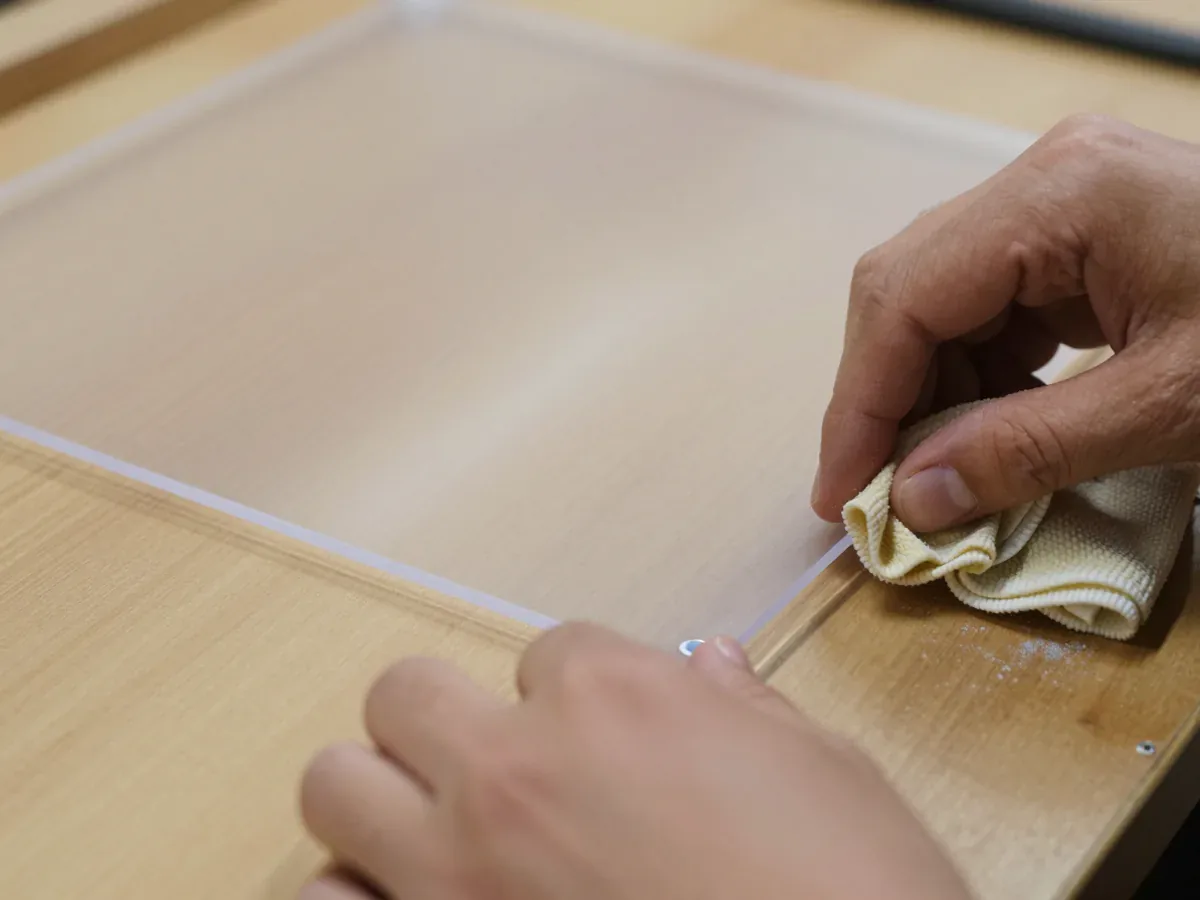
The material line on most orders says clear PP and stops. That word covers a range of thicknesses and a range of stiffness, and the difference between them is the difference between a bag that stands open while a worker fills it and one that folds shut.
Write the grade as a sentence: clear PP, thickness stated in microns, with the shell wiping clean so the same bag goes back out on the next job. The wipe-clean property matters for storage operators who reuse bags across seasons, and it belongs in the spec because it drives the surface finish.
Verify it by feel and by fold. Take a bag, fold the panel corner to corner, and release. A panel that springs back part way holds its shape under load. A panel that creases flat will sag once the bag carries weight. Check the surface with a dry cloth and confirm that dust lifts rather than smears.
Handles and Webbing: The Load Path Written Into the Order

The handle line is where a heavy duty clear storage bag earns its name. Navy webbing runs from the handle down the side of the bag, and that run is the load path. If the webbing stops at the top seam, the entire load hangs on a few centimetres of stitching.
Write the webbing as a length and an attachment: navy webbing, width stated, stitched from the handle down past the side seam, with reinforced stitching at both ends. The reinforced handle construction is what supports significant loads, and the spec should say where the reinforcement sits.
Check it by loading a sample bag to its rated weight and lifting it by one handle for thirty seconds. Watch the stitching where the webbing meets the panel. A handle that holds on a straight lift but pulls at the anchor point under a single-hand lift will fail in a stairwell, not in a warehouse.
Binding, Panel and Window: Why Colour Belongs in the Spec

Binding colour looks like a branding choice. On a clear bag it is also a structural marker. Black binding frames the clear panel so the bag reads as a product on a shelf, and white binding on a clear PP shell gives the edge a finished line that hides stitch wander.
Write the binding as colour plus width plus fold. A line that says white binding, 20 mm, double folded over the panel edge tells the binding station what to feed and how to close it. Leave the fold out and two runs can look identical on the shelf while one has a raw edge inside.
Check the binding at the corners first. A corner where the binding puckers or gaps is a corner that will open under load. Run a thumb along the inside edge of ten bags and feel for a raw panel edge that slipped past the folder.
Zip and Opening: The Line That Decides Daily Use

A full length zip changes how a bag is packed and unpacked. A wide lid opening means the whole top opens, not just a slit, and that difference decides whether a worker can load bedding or blankets in one motion or has to feed them through a gap.
Write the opening as geometry: full length zip across the top, lid opening width stated, zip gauge stated. Add the pull type, because a small pull on a heavy lid is the first thing to break in daily handling.
Check the zip by opening and closing a loaded bag ten times. A zip that runs smooth empty can catch once the panel is under tension. Watch the end stops, where the zip meets the binding, because that junction takes the pull every time the bag is closed.
Label Pocket and Visibility: Specifying What the Staff Sees
The standard clear bag carries a clear label pocket on the face, and the pocket is the line that turns a storage bag into an inventory tool. Contents stay visible without unzipping, which speeds up unpacking and inventory counts on a loading dock.
Write the pocket as position, size and material. Face pocket, centred, sized to hold a standard inventory tag, clear film. If the pocket is sized to a tag the buyer already uses, the spec should name that tag size so the factory cuts to it.
Check the pocket by sliding a tag in and out five times. A pocket that grips too tight tears at the corner, and a pocket that sits loose lets the tag slide out in transit. Confirm the pocket film is clear enough to read a printed label through it at arm’s length.
Load Rating and the QC Checkpoints Behind It
A load rating of 20 to 25 kg on the spec sheet is a claim about the whole bag, not about the panel. The rating holds only if the handle anchor, the binding fold, the base seam and the zip end stops all meet the same standard, and that is why every order runs through four QC checkpoints.
Write the rating as a number plus the test that proves it. Rated 20 kg, verified by a static hang test on a filled sample at the start and end of the run. Naming the test turns a claim into an instruction the line can follow.
Check the record, not just the bag. Ask for the checkpoint results at cutting, binding, final assembly and packing. A run that passes the hang test at the start but skips the end-of-run test has no evidence for the cartons that ship last.
The Line Most Orders Leave Blank
The blank line is the one that connects the bag to the job. It describes what goes inside, how full the bag is expected to be, and how it is lifted. A bag rated at 20 kg carried by two hands at the base is a different product from the same bag lifted by one handle at the top.
Write it as a use note under the load rating: contents, fill level, carry method. A storage operator stacking bags on shelving needs a base that stays flat under a full load. A moving crew lifting by one handle needs the anchor reinforcement to carry the whole weight.
Check it against a real load before the run starts. Fill one sample bag with the actual contents at the expected fill level and carry it the way the end user will. If the bag sags at the base or the handle anchor pulls, the spec needs a change before the cutting table runs, not after the cartons are sealed.
FAQ
Should the load rating go on the spec sheet or only in the quote?
Put it on the spec sheet with the test that proves it. A rating in the quote is a commercial promise. A rating on the spec sheet is an instruction the line can follow and a checkpoint the inspector can check.
Does binding colour need to be specified if the bag is clear?
Yes, because binding colour sets the edge finish as well as the look. Black binding frames the clear panel for shelf display, and white binding gives a cleaner stitch line on a clear shell. The colour choice also tells the binding station which tape to load.
How is a clear panel checked at inspection without opening every bag?
Inspect the panel through the bag. Hold it against a light and look for haze, scratches and fold lines that will not relax. Then check the binding edge and the base seam, which are the two places where a panel problem shows up as a structural fault.
Can the label pocket be sized for a standard inventory tag?
Yes, and it should be. Give the factory the tag dimensions and the pocket can be cut to hold it snugly. A pocket sized to the buyer’s existing tag saves relabelling and keeps the inventory count readable through the clear film.