

Based on legacy size notes and product spec data for 75L, 93L and 125L moving bags.
Every August the same order pattern returns to the warehouse floor: retailers restocking for the autumn moving season, and with it the same quiet mistake. Last August a carton of 125L bags split at the seam before the pallet even reached the truck, while a stack of 93L bags beside it came through the same load without a mark. The 125L bag had been sold as the stronger option, and on paper it was. On the loading bay it was the one that gave way.
The buyer had ordered both sizes in the same woven PP shell, the same reinforced webbing handles, the same double stitching. The only difference was volume. That difference turned out to be the whole story, and it took a week of tracing back through the spec sheet to see why.
The Carton That Split Before the Truck Left

The split happened at the bottom seam of a 125L bag packed with folded quilts, roughly 40 kg of soft goods compressed into a shell rated for less. The bag had been lifted by one handle during a two-person carry, and the stitching on that side pulled through the woven panel. Contents spilled onto the concrete, and the load was repacked into two 93L bags that had been sitting idle on the same pallet.
What made the failure strange was the comparison sitting right next to it. The 93L bags in that shipment carried duvets and pillows at around 18 to 22 kg each, well inside the 20 to 25 kg handle rating. They were lifted the same way, stacked the same way, and loaded onto the same truck. None of them failed. The larger bag was not weaker in construction. It was weaker in the only place that mattered: the ratio between what it could hold and what it could safely carry.
Tracing Back to the Spec Sheet Line

The spec sheet listed both sizes under one heading, with a single weight line: 20 to 25 kg. That line was accurate for the 93L bag and misleading for the 125L one, because volume and load capacity are separate engineering decisions. A 125L shell invites a packer to fill it, and a full 125L bag of dense goods will pass 25 kg long before the fabric looks strained.
The buyer had read the weight line as a property of the material, not a limit tied to a specific size. The factory had quoted the same handle specification for both bags because the handles were physically identical. Nobody had written down what the larger volume would do to the load once a packer filled it. The spec sheet answered a question about materials and left the question about packing unanswered.
What 75L Actually Carries in a Warehouse
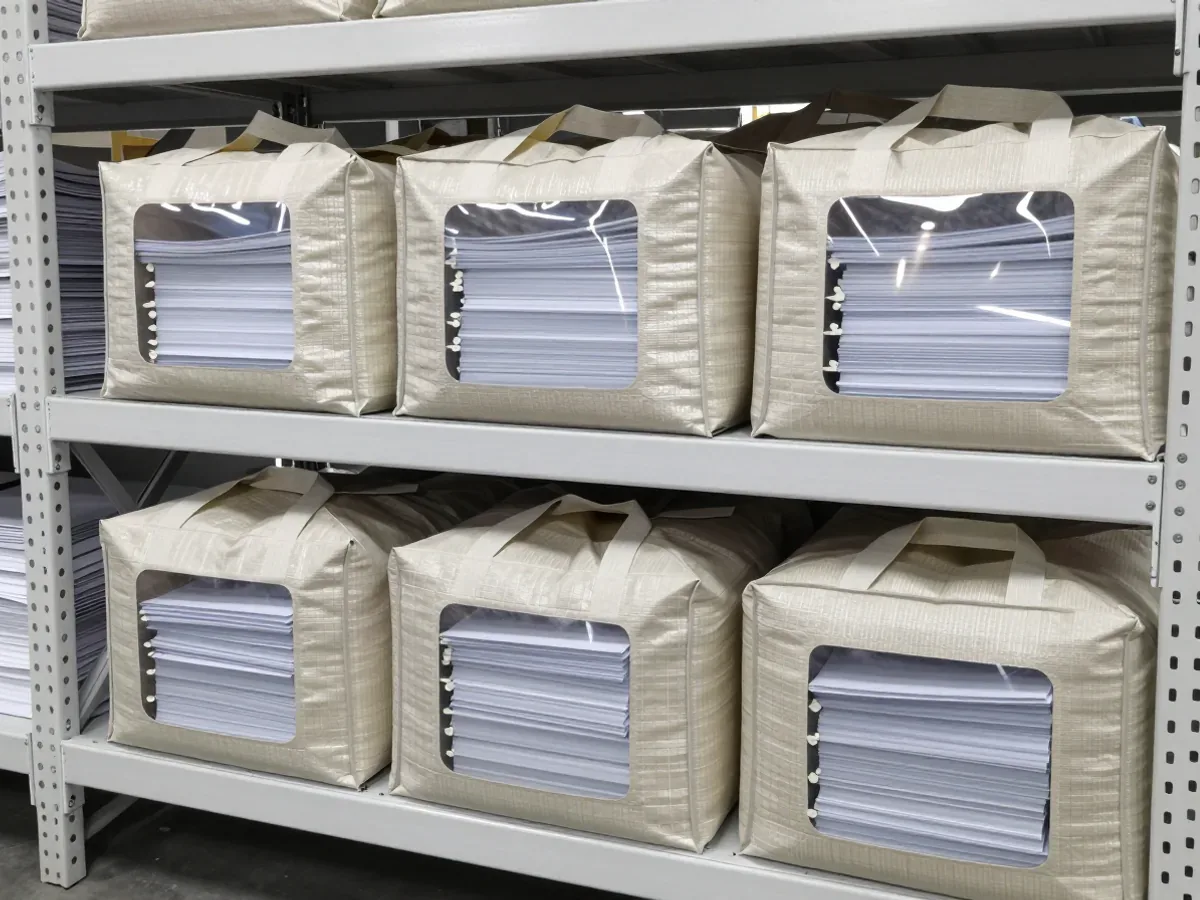
A 75L bag is the workhorse of bulk clothing, textiles and documents, and its box-like shape is what makes it useful. The rigid frame and reinforced piping let it hold form on a shelf, so folded shirts or files stack instead of slumping. Woven PP with a PE coating keeps moisture and dust out during long storage, and the double-stitched webbing handles are built for the 20 to 25 kg range.
In practice a 75L bag earns its place when the contents are dense but the count is controlled. A warehouse picking team can fill one with apparel and still lift it by a side handle without a second person. The clear panel version saves time on identification, and the foldable build means empty bags collapse instead of eating floor space. The size works because the load stays predictable.
Where 93L Earns Its Place for Bedding

The 93L bag is the all-rounder for bulky soft goods, and bedding is where it holds up best. A king-size quilt, several comforters or a stack of large pillows fit without being over-compressed, which matters because forcing textiles into a smaller shell damages the filling. Seasonal collections and consolidated bedding sets move through this size cleanly.
The 93L format also keeps the load honest. Soft bedding is light for its volume, so a full bag usually lands inside the handle rating rather than above it. Moving companies and home goods retailers use it because the bag protects the item and the carrier can still lift it alone. The rectangular frame stacks neatly on warehouse shelves and packs tightly in a truck, and the waterproof coating does the same job it does on the smaller size.
The 125L Trap: Volume Without a Weight Plan
The 125L bag holds about 44 gallons and is built for loads that would otherwise need a roof rack or a second trip. It bridges the gap between standard boxes and industrial bins, and for bulk logistics it is a genuine workhorse. The trap is that the volume invites filling, and filling a 125L shell with dense goods pushes past the handle and seam limits that the same shell carries comfortably at 93L.
Reinforced models are quoted at higher load capacities, and material options range from flexible LLDPE to rigid polyethylene to fabric with internal metal frames. None of that changes the packing math. A 125L bag packed with quilts at 40 kg will stress the bottom seam and the handle stitching in a way a 93L bag at 20 kg never does. The larger size needs a weight plan written next to it, not just a bigger number on the label.
Handle and Seam Evidence From the Floor

The failure left physical evidence that was easy to read once the bag was opened flat. The bottom seam threads had snapped along a run of about 5.9 in, and the webbing handle on the lifted side had pulled through the woven panel at the stitch line. The fabric itself was intact. The stress had gone to the two places where a bag concentrates load: the seam and the handle anchor.
On the 93L bags from the same shipment, the same seams and handles showed no distortion after the same handling. The difference was the weight each bag carried relative to its rated capacity. Handle failure, seam bursting and zipper damage are the usual outcomes when a bag is pushed past its engineered limit, and they tend to appear at the worst moment, which is mid-lift. The floor evidence pointed to load, not to a defective batch.
The Measurement Method That Prevents the Rewind
The fix starts before the order, with a measurement that matches the bag to the load rather than the load to the bag. Measure the product’s width left to right, add its depth front to back, and add half of the depth again as an allowance for fit and closure. That gives a shell dimension that lets the contents sit without compression, which is the same logic behind the 27.2 × 13.8 × 15 in shell most home moves are built from.
Then weigh a filled sample before signing off the size. A 29.1 in length bag takes a duvet, four pillows or a full wardrobe shelf, and the packed weight tells the buyer whether the handle rating holds. If the filled weight lands above 25 kg, the answer is a smaller bag or a two-bag split, not a stronger handle. Every order runs through 4 QC checkpoints, and the packed-weight check belongs at the first one, before the size is locked.
What to Sign Off Before the Next Size Order
The sign-off sheet for a mixed size order should carry one weight line per size, not one line for the whole family. Write the packed weight target beside each volume, and note the handle rating against it. For the 125L bag, add a packing instruction that caps the fill weight and names the goods it is meant for, so a packer does not treat volume as permission.
Check the handle anchor and the bottom seam on a filled sample at the target weight, lifting from one handle the way a mover would. Confirm the zip closes from either end where the top has two pulls, and confirm the label pocket holds a card that identifies the contents. A bag that passes at its own rated load is the only bag worth reordering, and the size on the label should match the job it was measured for.
FAQ
Is a 125L moving bag always stronger than a 93L bag?
No. The 125L bag holds more volume, but strength depends on the load it carries against its handle and seam rating. A 125L bag filled with dense goods can fail where a 93L bag at a lighter packed weight holds.
How does the buyer measure a load before choosing between 75L and 93L?
Measure width and depth, add half the depth as an allowance, then weigh a filled sample. If the packed weight stays inside the 20 to 25 kg handle range, the smaller size works. If it climbs above, split the load or step down a size.
What weight limit should the buyer expect from a heavy duty moving bag?
Most heavy-duty moving bags are designed around a 60 to 65 pound limit, roughly 20 to 25 kg, with reinforced webbing handles and double stitching. Confirm the rating for the specific size, because the same handle spec carries differently at 75L and 125L.
Can a bedding bag with a clear window be used as a moving bag?
A bedding bag such as the 23.6 × 16.9 × 13.8 in shell with a clear window is built for a duvet, not for general moving loads. The window helps identification, but the size and rating suit soft bedding rather than dense goods.