

Built from the moving bag spec sheet and the defect terms buyers already negotiate, with the claim evidence each line should trigger.
A buyer forwarded a competitor's spec sheet last spring with one line highlighted: "Warranty covers manufacturing defects." The buyer wanted to know whether that sentence was stronger or weaker than the sheet already sitting on her desk. Read side by side, the two documents promised the same thing in different words, and neither one said what would happen when a handle tore out in a stairwell.
That comparison is where most warranty arguments begin. A moving bag claim does not fail at the moment of damage. It fails months earlier, on a spec sheet that left the important lines vague or blank. What follows is a walk through the lines that decide the outcome, in the order they appear on a typical purchase order, with what to write, why it matters, and how to check it when the cartons arrive.
The Line That Reads 'Double-Needle Lockstitch, 6 SPI Minimum'

Most moving bag failures start on the stitch line rather than in the fabric body. A seam built with double-needle lockstitch and a minimum of six stitches per inch is designed to hold a rated dynamic load; a single-needle seam on lighter material gives way well below that rating. The spec line exists so the claim has a measurable standard to point back to.
Write the stitch type, the minimum SPI, and the thread specification together. Bonded nylon thread holds up better under friction than polyester, and a sheet that names only the stitch pattern leaves the thread open to substitution. Ask to see the actual thread spool during a factory audit rather than a photo in a brochure.
At receiving, pull a sample bag and count stitches per inch along the side seam and the bottom panel. Run a gloved finger along the seam for skipped stitches and uneven tension. A single skipped stitch under load can propagate into a full seam failure, and that photograph is the first piece of evidence a claim will need.
The Bartack Line Every Handle Point Needs
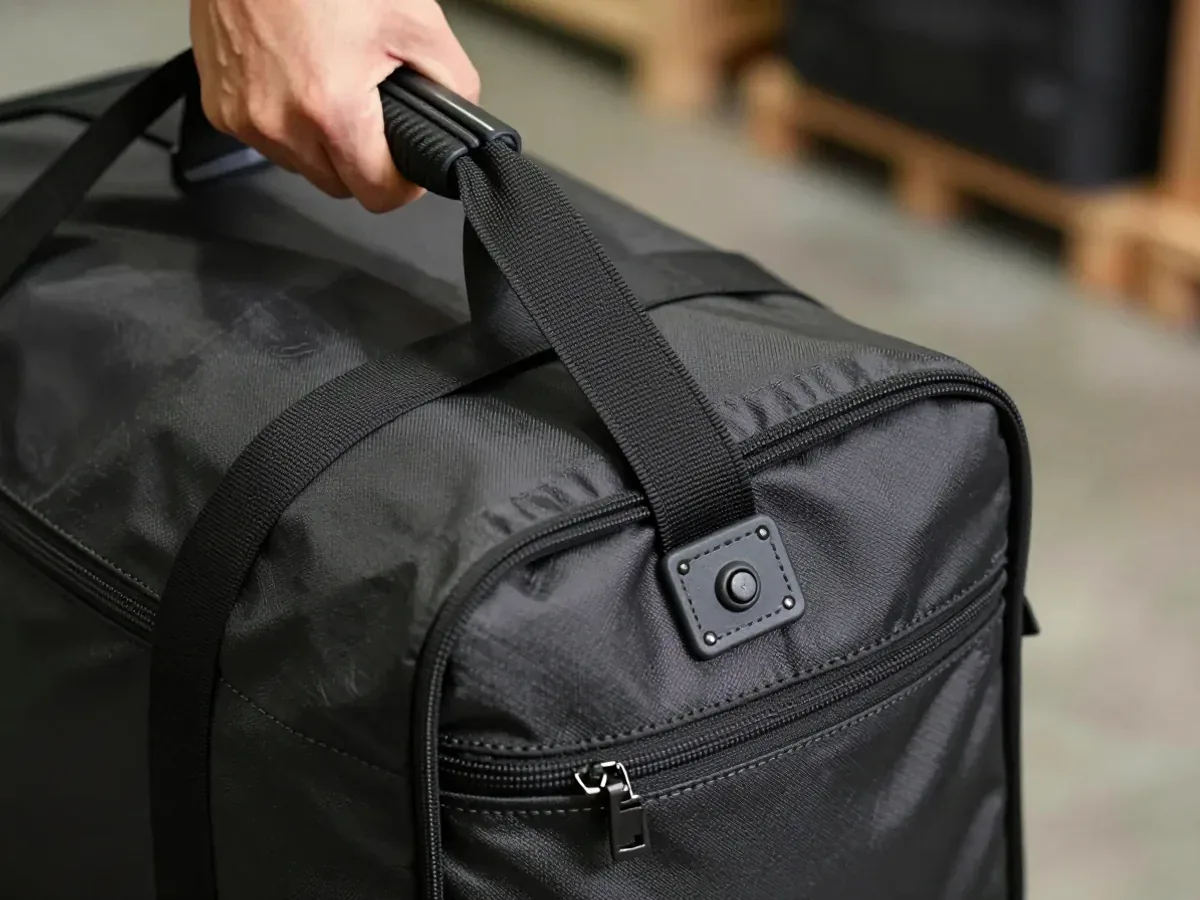
Handles tear out at the connection points, and the bartack is the only reinforcement standing between a full bag and a dropped one. The sheet should require a bartack of at least fifteen tack stitches at every handle connection point, not just the two most visible ones. A factory that bartacks the front joins and skips the back ones has met the letter of a loose spec and missed its purpose.
The check is physical and quick. Clamp a handle, lift a loaded sample, and let it bounce. If the thread pulls or the fabric puckers around the tack, the bartack density is wrong. Handle stitching reinforced at the join is one of the details worth confirming on the sample before production, because it is far cheaper to fix there than in a claim.
The GSM Line on the Cutting Table

Fabric weight is the quiet variable in every load rating. A bag advertised at 200gsm that arrives at 160gsm loses roughly a quarter of its dynamic load capacity, and no stitch specification will recover that loss. The sheet should state the fabric weight and the tolerance allowed, and the tolerance should be narrow enough to matter.
Verification happens at the cutting table, not after sewing. A portable GSM cutter and scale, used on three rolls per batch, takes minutes and settles the question before the fabric becomes bags. Spot checks on finished bags cannot separate a light roll from a heavy one once the panels are cut and stacked.
The Batch Code Line on the Carton

Without batch-specific photos, a claim has nothing to attach to. Every carton needs a legible batch code that traces back to the production day, shift, and machine, and the code has to survive the journey. A code printed on a label that peels in transit is the same as no code at all.
The receiving check is simple: photograph the carton label and the bag label together before the pallet is broken. Tie every defective bag to a specific purchase order, delivery date, and lot number. When a supplier asks which production run a failed bag came from, the answer should take seconds, not a search through email.
The Load Rating Line and What It Does Not Cover
A load rating is a number with conditions attached, and the conditions are where claims are won or lost. Overloading voids a warranty, and so does uneven packing that concentrates stress on a single seam and causes failure below the rated limit. The sheet should state the rated load and describe the packing condition the rating assumes.
A written load log at receiving closes this gap. Record the actual content weight and how it was distributed for each test bag. When a bag splits at a weight below its rating, the log shows the load was within spec and the failure belongs to the bag. Without it, the supplier can argue the crew overloaded the bag, and the argument is hard to disprove after the fact.
The Defect Terms Line: What Counts and What Does Not
The defect terms line is where a spec sheet turns into a contract, and vague language here is expensive. Handle tear-out at the bartack, lockstitch seam splitting along the side or bottom panels, zipper track separation during normal fill, and fabric puncture below the rated load all belong on the covered list. Cosmetic issues such as slight colour variation within an agreed tolerance, minor surface abrasion from transit, or a small misprint offset do not trigger replacement unless a separate aesthetic standard was negotiated.
Write the covered failures as named events, not as “manufacturing defects.” A named event can be photographed and matched to a batch. A general phrase invites a discussion about whether the failure was the factory’s fault or the crew’s, and that discussion rarely ends in the buyer’s favour.
The Evidence Line Nobody Writes Until the First Claim

The strongest document in a moving bag claim is dated video of a random sample from the failing batch being loaded to its rated weight and lifted repeatedly, with the stitch lines and handle joins in frame. A third-party lab report from six months earlier covers a single sample, not the production lot in the warehouse. The spec sheet should require this footage as a delivery document, batch by batch.
The same logic applies to the buyer’s own evidence. Photograph every torn seam and popped handle before moving the damaged stock, with a date stamp and a ruler in frame, and shoot the batch code alongside the failure. A claim assembled this way converts a subjective complaint into an objective record, and suppliers settle objective records faster.
The Line Most Buyers Leave Blank
The line that gets skipped is the one setting the claim process itself: who is notified, in what form, within how many days, and what response time counts as an answer. A sheet that defines the defect but not the procedure leaves the buyer guessing at the moment when guessing is most costly. Most direct factories confirm receipt of a claim within about two days and dispatch replacement stock inside ten to fourteen business days when inventory is on hand. Custom runs take longer, and the sheet should say so before the order is placed.
Filling in that line changes the tone of every later conversation. The supplier knows the clock started, and the buyer knows when to escalate. It is a small block of text, usually fewer than forty words, and it does more for claim survival than any single specification above it.
Questions That Come Up After the First Claim
Does a moving bag warranty cover a bag that split while being dragged up stairs? Dragging is not the load condition the rating describes, and a claim built on it invites a dispute about use. The stronger case is a bag that failed under a rated load during a normal lift, documented with the load log and dated photos.
Can a claim be filed if the carton label is missing but the bag label is intact? The bag label can carry the batch code, and photographs of it alongside the failure are usually enough to open a claim. Carton records make the case cleaner, which is why the label is photographed at receiving.
Is cosmetic colour variation covered under a moving bag warranty? Not unless a separate aesthetic standard was negotiated and written into the sheet. Slight variation within an agreed tolerance, transit abrasion, and small print offsets sit outside the defect terms.
How long should a supplier take to answer a moving bag claim? Set the expectation in the spec sheet before the first order. A confirmation within two days and a replacement decision inside two weeks is a workable standard for stock items, with custom runs given a longer window in writing.
What the Sheet Decides Before the Bag Does
A moving bag claim survives on paper long before it survives in a warehouse. The stitch line, the bartack count, the fabric weight, the batch code, the load conditions, the defect terms, the evidence requirement, and the claim procedure each remove one way for a supplier to argue. Skip any of them and the argument moves to the buyer’s side of the table.
The practical next step is a line-by-line review of the current spec sheet against these eight items, followed by a receiving routine that photographs labels, logs loads, and films a random sample under rated weight. That routine costs an afternoon per shipment. It is also the difference between a claim that gets settled and a claim that gets explained away.