

Built from archived TIIOCTI notes on needle detection and metal contamination in bag exports, plus the moving bag product spec.
The purchase order sat on the table with one line near the bottom: "Needle detection required." Six words, no machine, no sensitivity, no record of who checks the machine or how often. A receiving audit at a retailer later found a broken needle fragment in a seam, and the order turned into a recall conversation. The line had been there the whole time. It just did not say enough to hold anyone to anything.
That single line is where most metal contamination programs succeed or fail. Not at the machine, not at the packing table, but at the moment someone decides how much detail the order deserves. A detection certificate worth its paper names four things: the machine and its calibrated sensitivity in millimeters, the verification cadence with test-piece records for the production window, the lot or PO number the pass applies to, and a 100 percent pass statement for the shipment quantity. Anything less answers none of the questions an auditor asks.
The sections below walk through the order line by line, in the order a buyer would fill it in, and end at the blank most buyers never notice.
The One Line That Says Needle Detection Required

The first version of the line usually reads like a wish. It names the check and stops. That is enough to start a conversation and not enough to close one, because a factory can satisfy the words without ever proving the machine was sensing anything.
The reason to expand it is timing. Needle detection is the compliance step bag and textile buyers most often discover too late, usually after a receiving audit has already opened a carton. By then the shipment is sealed, the certificate is whatever was emailed at dispatch, and nobody can reconstruct the production window.
What belongs in this first line is the scope: which units get scanned, at what stage, and against which order. A finished bag scanned after packing is a different claim from a bag scanned before the final seam. Write the stage down, because the passing unit has to be the shipping unit, with no metal-added steps after the scan.
Naming the Machine and the Ferrous Sphere Size

The next line names the equipment and its sensitivity. Needle detection machines sense ferrous metal magnetically, and their sensitivity is stated in millimeters of ferrous sphere, commonly 1.0 to 1.2 mm for bag production. That number is the whole claim. Without it, “detection required” could mean a machine set to catch a coin.
The physics matters here. Metal detectors find ferrous fragments reliably down to about a millimeter, and non-ferrous metals only at larger sizes. They find nothing that is not metal: plastic needle tips, glass, and bone buttons pass through. Detection also differs from X-ray, which sees non-ferrous contamination too. For bag production the practical risk is broken sewing needles and their fragments, all ferrous, so a ferrous sphere spec covers the realistic failure.
How to verify it: ask for the machine’s calibrated sensitivity in millimeters on the certificate, and watch a test piece go through at the start of a shift. A machine that has never been challenged with a test piece is a machine nobody has checked.
The Verification Cadence and Its Test Piece Records
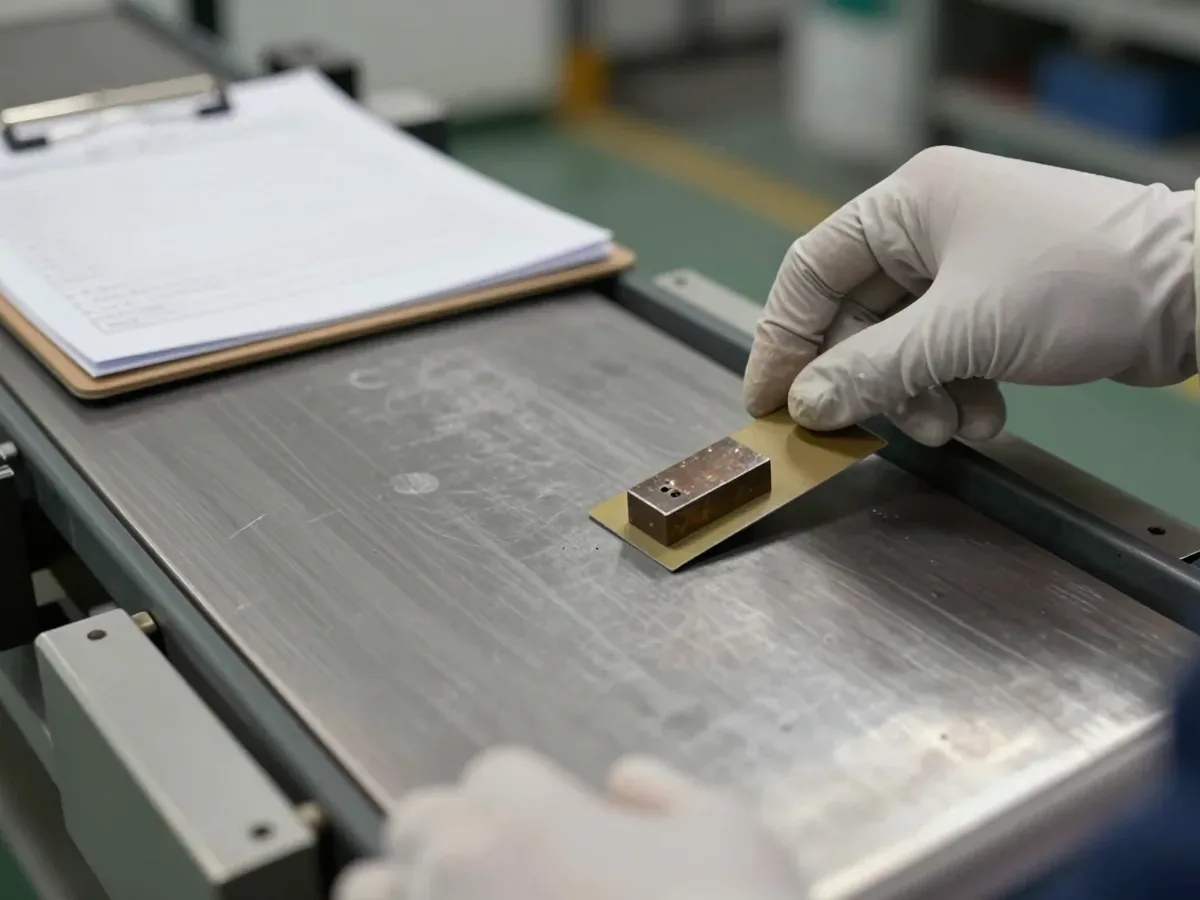
A sensitivity figure describes one moment. A cadence describes the whole production window, and the window is what the buyer is actually buying. Calibration test pieces run at shift start, mid-run and end prove the machine was sensing during the whole window, not just during the demo.
Write the cadence into the order as a schedule, not an intention. Shift start, mid-run, end of shift is a workable pattern for most bag lines. Then require the test-piece records to travel with the shipment, because a record kept only at the factory cannot answer a question asked at the port.
The verification step is simple and easy to skip. During an audit, ask to see the log for a specific date and match it against the production report for that date. If the two do not line up, the cadence exists on paper only.
The Lot or PO Number the Pass Applies To

A certificate without an identifier is a document about nothing in particular. The lot or PO number ties the pass to a specific set of bags, and it is the difference between a claim and a receipt.
This line also protects the factory. When a certificate names the PO, a later dispute about a different shipment cannot be pinned on the wrong scan. When it does not, every shipment looks the same and every claim is arguable.
To verify, pull one carton from the shipment and match its carton label to the PO on the certificate. Then check that the quantity on the certificate matches the quantity in the container. A pass statement for 4,800 pieces does not cover a shipment of 5,200.
The 100 Percent Pass Statement and What It Does Not Cover
The order needs a sentence that says every unit in the shipment quantity passed through the detector. That is the 100 percent pass statement, and it is the line auditors look for first.
It does not cover everything, and buyers should know the edges. It does not cover non-ferrous fragments at small sizes, because the machine cannot see them. It does not cover contamination introduced after the scan, which is why packing steps after detection need their own control. It does not cover a machine that was switched off, which is why the cadence records sit next to the statement.
The verification here is arithmetic and sequence. Count the units, confirm the scan point sits before packing, and confirm nothing metal-bearing enters the bag after that point. A 100 percent statement is only true if the sequence makes it possible.
Where the Broken Needle Policy Belongs on the Same Sheet

Detection is the verification layer. The policy prevents fragments from existing in the first place, and the two belong on the same order sheet because one without the other leaves a gap.
A broken needle policy that requires presenting every fragment before a replacement needle is issued removes the loose-fragment problem at the source. The sewing floor keeps a broken needle log, and every snapped needle is accounted for in all its pieces. No fragment, no new needle. That single rule changes how operators treat a snap.
Write the policy reference into the order next to the detection line, and require the log to be available at audit. Programs with both controls have the low incident rates. Programs with detection alone are checking for something the floor is still allowed to lose.
The Line Buyers Most Often Leave Blank
The blank is not the machine or the sphere size. It is the packing sequence after detection. Most orders state that bags are scanned and stop there, leaving the steps between the scan and the sealed carton unwritten.
That gap is where the certificate loses its meaning. If a bag is scanned, then trimmed, then packed with a metal clip or a stapled tag, the passing unit is no longer the shipping unit. The order has to say that no metal-added step follows the scan, or name the steps that do and how they are controlled.
The fix is one added line: detection point, then packing, then carton seal, with nothing metal-bearing in between. It costs nothing to write and closes the only hole the machine cannot see.
Questions Buyers Ask Before Signing the Order
Is needle detection legally required for bag exports? Not by universal law. Japanese retail programs require it in practice, and school-supply and UK programs increasingly follow. The requirement lives in the buyer’s vendor manual, not in customs law, so the order is where it becomes enforceable.
Can a metal detector catch a brass or stainless fragment? Metal detection senses ferrous metal best. Brass and stainless fragments need larger sizes or X-ray equipment to catch reliably, which is why the ferrous sphere spec is written around sewing needle risk rather than general metal.
What ferrous sphere size should a bag order specify? Commonly 1.0 to 1.2 mm for finished bags, verified with test pieces each shift. The number should appear on the certificate in millimeters, next to the machine identity.
Does a detection certificate replace a broken needle policy? No. The policy prevents fragments from existing; detection is the verification layer. An order that carries both, plus the packing sequence line, gives an auditor a complete story from sewing floor to sealed carton.