
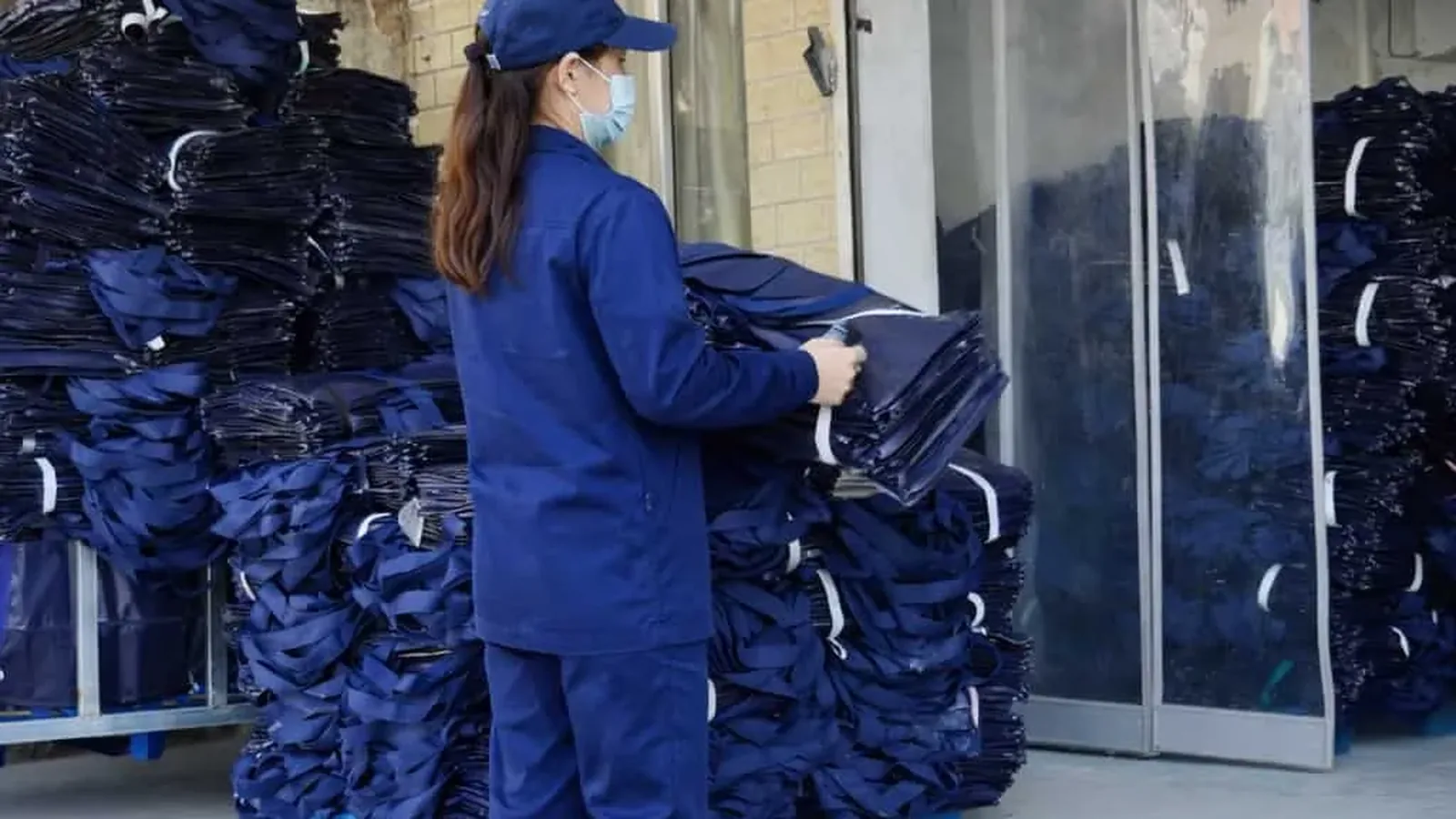
This walk follows one reusable bag order for a twelve-store outdoor retailer, station by station, using the spec and packing details held on file.
On the sewing floor, the handle station is the slowest stop in the line, and it is where a twelve store order first shows its seams. Two operators feed webbing through the same machine that runs the shared stock, and every bag that leaves this table has to match the one before it. The order behind them is not complicated: one bag, one brand, one price, shipped to twelve locations. What makes it fragile is everything that happens before and after this table.
A reusable bag is a standardised item, so a retailer can roll out a multi store program from a single spec and a single supplier. The bag carries the brand, the price stays consistent, and the inventory is shared, which means a store that runs low draws from the same pool. That simplicity is real, and it is also where the mistakes hide. A walk from the order file to the container seal shows where a twelve store program actually breaks down, station by station.
The order file that decides everything downstream
Before any fabric is cut, the order file has to answer three questions in writing: what the bag is, how many pieces each store receives, and how those pieces are packed. A program order typically starts at roughly 5,000 to 20,000 pcs, matched to expected traffic across all stores with a buffer for the shared inventory. That range is a starting point, not a forecast, and the file should say so.
The pack-to-store plan belongs in this file, not in a later email. Per store packing, barcode labels and retail packing are all possible, but the choice has to be agreed before production starts. When the packing method is decided after cutting, the carton plan gets rebuilt under time pressure, and that is the first place a rollout slips.
A size or fabric change is carried on one sample, and logo printing, labels and woven tags sit in the same brief. If the file separates the artwork from the bag spec, the print position and the handle length get approved on different days, and the line receives two versions of the same order.
At incoming material, the fabric is checked against the approved spec
The first checkpoint sits at the material bay. Fabric, webbing, zips and thread are checked against the approved spec before anything is released to the floor. For a twelve store program this check matters more than usual, because one roll of webbing feeds every store's bags. A shade difference here does not stay local.
The common misalignment is a spec that describes the bag but not its components. The shell fabric gets a weight and a colour, while the webbing gets a name and nothing else. Then the first carton arrives with handles that feel different from the approved sample, and no one can say which document was violated.
Ask for the component list to be checked line by line against the sample. Webbing width, zip type and thread colour should each have a value, not a description. A material that passes this gate cannot surprise the sewing floor three weeks later.
At cutting, one size line has to hold for every store
Cutting is where a single spec either holds or quietly splits. The size line on the order is one number, and every store receives bags cut from it. If the cutting table works from a marker that was adjusted for yield, the finished bag can drift a few millimetres without anyone noticing until the final check.
The check at this station is simple: measure the first cut panel against the approved dimensions, then measure again after the bundle is stacked. Fabric relaxes, and a panel that measured correctly at the top of the pile can sit differently at the bottom. For a program shipping to twelve locations, that drift becomes twelve separate complaints.
This is also the moment to confirm the handle attachment points are marked from the same template. A shifted handle position is invisible in a folded bag and obvious in a customer's hand.
At sewing, handles and seams run beside the shared stock
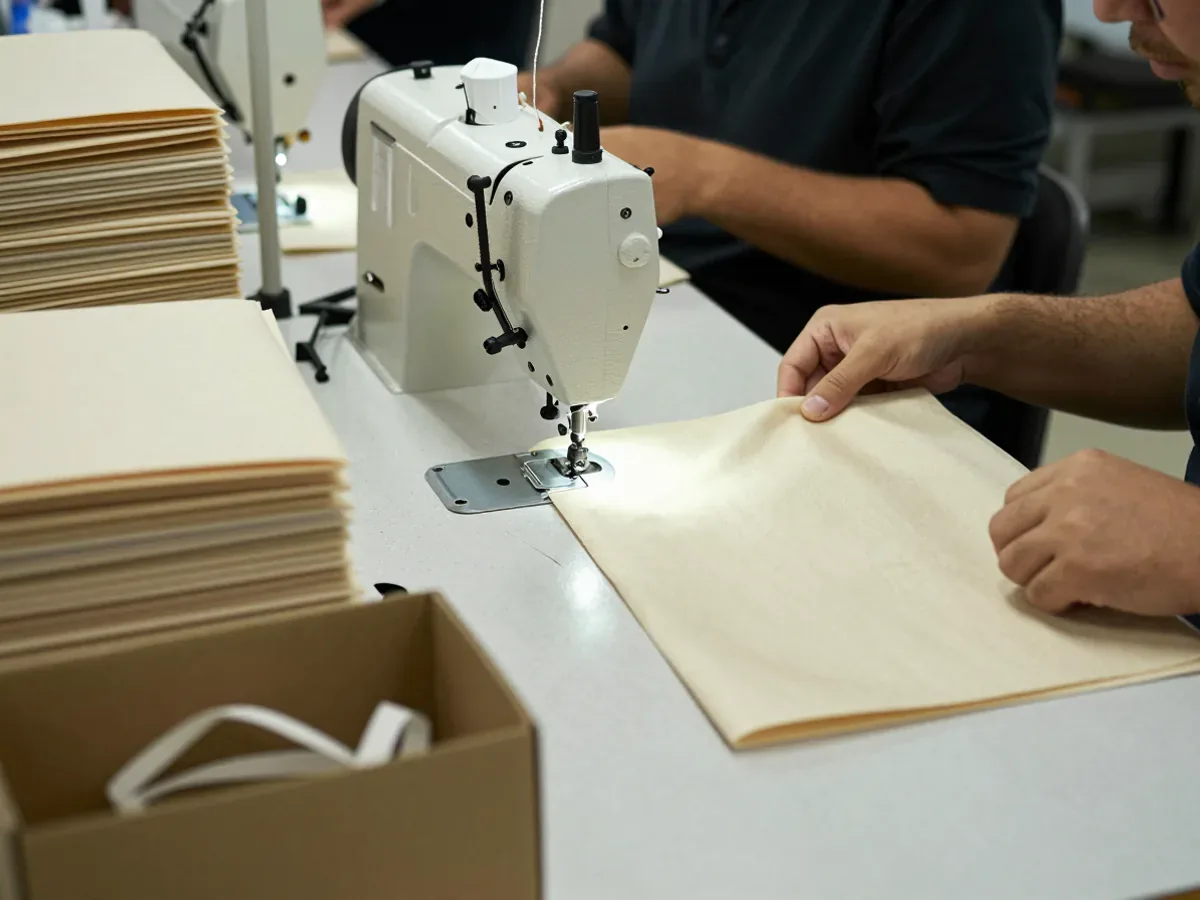
Handles, zips and seams are sewn on the same floor as the stock runs, which keeps a change close to the line but also means the program shares its capacity with everything else in production. The handle station is the slowest, and it is the first place a deadline gets squeezed.
The check here is a seam and handle pull on bags taken from the middle of the run, not the top. Stitched seams behave differently from sealed ones, and the bags are stitched rather than sealed, so the seam is a thread decision as much as a machine one. A bag that resists a splash is not a waterproof bag, and the sewing floor is where that distinction gets lost in conversation.
Watch the box of rejected handles beside the station. If it fills faster than the finished bag box, the webbing or the needle size is wrong, and the problem will repeat across every store's allocation.
At final check, dimensions, logo and packed quantity are counted by hand

The finished bag is checked by hand: dimensions, handles, logo and packed quantity. This is the fourth checkpoint on the line, and it is the one that catches what the earlier stations missed. A logo printed two centimetres off centre passes a glance and fails a tape measure.
For a multi store rollout, the count matters as much as the bag. Each store's allocation has to be counted into its own bundle before those bundles become cartons. When the count is taken at the carton stage instead, a short store is discovered at receiving, and the shared inventory has already been drawn down.
The check is a sample pulled from each store's bundle, measured and photographed against the approved sample. The photo becomes the reference for the packing station, not a record for later.
At packing, per-store cartons and barcodes are built before the seal

Packing is where the program either arrives store ready or arrives as a pile. Polybag, retail or per store packing is agreed before production, and this station executes that agreement. A carton built for store seven should carry store seven's barcode and store seven's quantity, with nothing left to sort at the back door.
The misalignment here is usually a label printed from the wrong list. The carton count is right, the bag count is right, and the barcode belongs to another store. Because the cartons look identical from the outside, the error survives until a scanner rejects it.
Check the first carton of each store's run against the pack-to-store plan, then check the last. If both match, the middle is likely sound. If the plan changed mid production, the packing station needs the revised version in hand, not in an inbox.
At the container, cartons are counted and photographed before the seal

The last station is the container. Cartons are counted and photographed before the seal goes on, which turns a shipment into a record. For a twelve store order, the photograph should show carton labels clearly enough to read the store allocation, not just the stack height.
This is also the final chance to catch a carton that was packed to the old plan. A count against the loading list takes minutes. A recount at a distribution centre takes days and puts the launch date at risk.
The seal closes the walk. Everything the program needed to prove has already been proven or already been missed, and the photograph is the only evidence that survives the journey.
What the walk proves about a single-spec program
A twelve store program works because the bag is the same product at every location. One spec, one brand and one price keep the rollout a logistics task rather than twelve design tasks. The walk shows that the risk is not in the bag's design but in the handoffs between stations, where a single number can drift or a single label can point to the wrong store.
The stations that matter most are the ones with documents attached: the order file, the material spec, the pack-to-store plan and the loading list. When those four agree, the sewing floor and the packing table have something to match. When they disagree, the bag still gets made, and the program breaks down somewhere between the container and the shop floor.
FAQ
Can each store receive its own carton quantity and barcode?
Yes. Bags can be packed per store with a barcode label or in retail packing, provided the pack-to-store plan is agreed before production starts.
What quantity should a first multi-store order start at?
A program order typically starts at roughly 5,000 to 20,000 pcs, matched to expected traffic across all stores with a buffer for shared inventory.
Is one sample enough when a size or fabric change is requested?
A size or fabric change is carried on one sample, and logo printing, labels and woven tags can sit in the same brief, so one round can cover the change.
Are the bags waterproof?
The fabric resists splashes, but the seams are stitched rather than sealed, so the bags are not waterproof.






