

A side-by-side comparison of two retail pack formats for custom tote bags, built from tear-line, color tolerance and packing specs used on the production floor.
A sample came back from a retail buyer with a single note clipped to the flap: the tear strip had opened in the return carton, and the totes inside were loose. The note did not mention print quality or fabric weight. It mentioned the moment a store associate tried to get the product onto a shelf.
That note sits in front of two packaging files on the same desk. One is a standard corrugated display box with a perforated tear line. The other is a reusable fabric sleeve that wraps the tote and doubles as part of the product. Both are called retail ready packaging. Both can pass a dock inspection or fail it, and the difference rarely shows up in a quote.
Two Retail Pack Formats on the Same Table
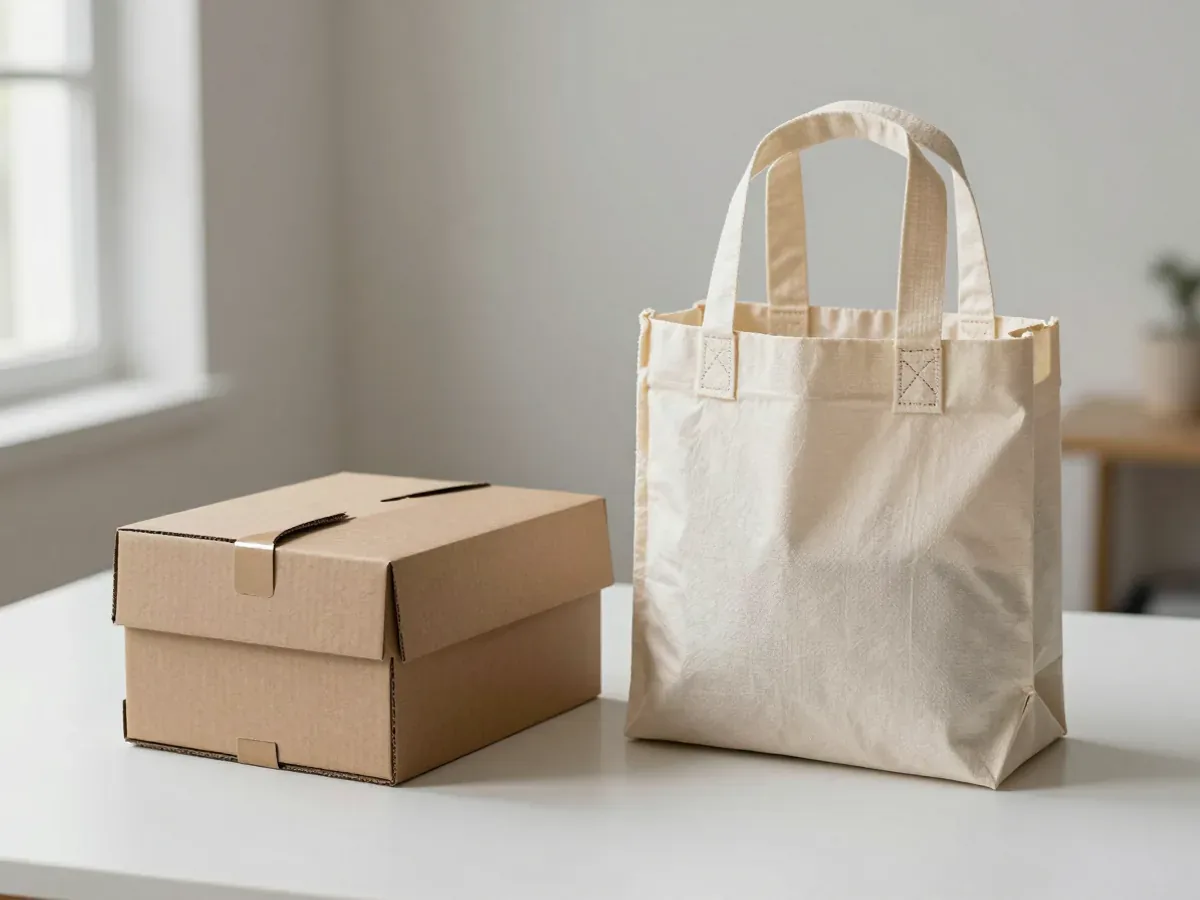
The corrugated display box is the familiar option. A branded outer carton holds folded totes, and a perforated strip or flip panel lets store staff open the display without a box cutter. The box becomes the shelf unit, so the tote arrives already merchandised.
The reusable fabric sleeve works differently. The tote sits inside a fabric wrap that carries the branding, and the wrap stays with the customer after purchase. There is no corrugated shell to break down, and no tear line to fail. The sleeve itself is the display and the takeaway.
Both formats solve the same problem: getting a soft product onto a retail shelf in a state that sells itself. The decision is not about which one looks better in a photo. It is about which one survives the receiving desk, the shelf, and the customer’s second use.
Opening Features: What a Store Associate Meets First
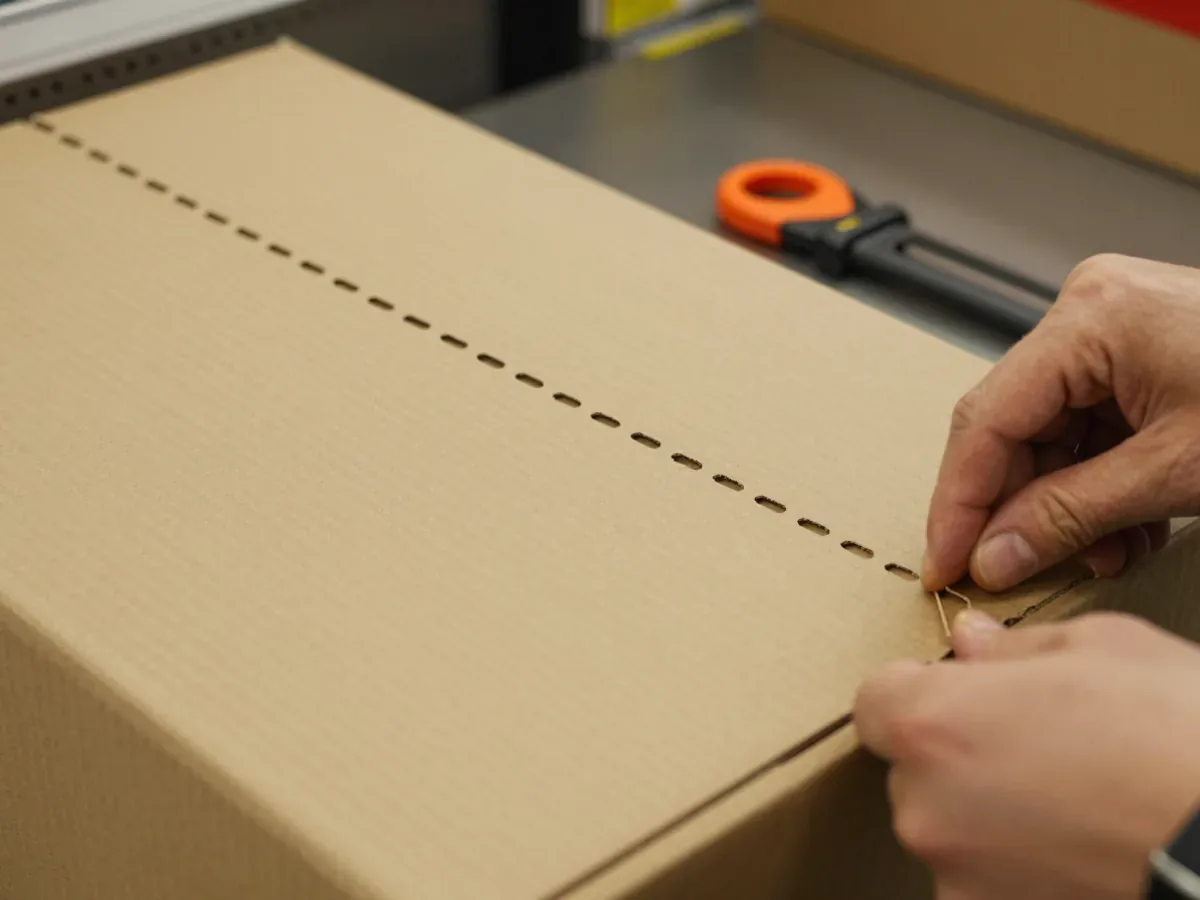
A store associate does not read the spec sheet. They meet the package with a box cutter in hand and a time limit. If the opening feature works, the totes are on the shelf in under a minute. If it does not, the display goes back on the pallet.
For the corrugated box, the tear line is the whole story. A clean perforation should run the full width of the display and release without tearing into the printed panel. The perforation must hold through transport and then give cleanly when pulled. A minimum of 10 lb per inch is the working threshold, measured to ASTM D5034. Below that, the line can split in the truck. Above it, staff need a blade.
The SKU label placement matters as much as the tear line. It should sit on a clear zone of at least 2 by 1 inches on the side face, where a scanner can reach it. Labels tucked under a flip top slow down receiving and invite a return to sender.
The fabric sleeve removes the tear line entirely, which is its quiet advantage. There is no perforation to test and no flap to buckle. The trade is that the sleeve must open and close cleanly enough to be reused, so the closure becomes the failure point. A sleeve that will not stay closed on the shelf is as bad as a torn display.
Color Control: Where Each Format Hides Its Risk

Color mismatch is the most common reason retailers reject custom packaging, and the two formats expose it in different places. The corrugated box prints on board. The fabric sleeve prints on textile. Ink behaves differently on each.
On corrugated, the substrate grain affects ink absorption, so a proof on coated paper tells you little. The proof must run on the exact board grade, and the color should be measured to a ΔE of 2.0 or lower under D65 daylight. A supplier who cannot show a spectrophotometer reading is unlikely to hit a Pantone swatch.
On fabric, the print method changes the risk. Screen print, heat transfer and woven labels each hold color differently, and the same Pantone can drift across a large run. A physical strike-off on the actual fabric and print method catches absorption and dot gain before bulk production. Skipping that step is how a brand ends up with a sleeve that reads one shade in the sample room and another under store lighting.
Lightfastness is the second exposure point for both formats, and it is easy to overlook. Shelf lighting, especially LED with high UV output, can fade a print within weeks. A 100 hour UV exposure test with less than 5 percent fade is a reasonable bar to request with the sample.
Cost, MOQ and the Hidden Rejection Line

The corrugated box is cheaper per unit and cheaper to tool. Setup dies for a display run in the hundreds to low thousands of dollars, and unit cost sits well below the fabric sleeve. The sleeve costs more because it includes the tote and the wrap in one item, and the per unit price reflects that.
The rejection line changes the math. Stores reject a meaningful share of shelf ready packaging at receiving because of poor opening features, and the reported range sits around 12 to 15 percent. A box that costs half as much but loses one unit in eight to rejection is not half as cheap. The effective cost climbs, and the brand absorbs the delay.
MOQ follows the same logic. A custom corrugated display typically starts at 500 to 1,000 units per SKU because of the die. A fabric sleeve program can start lower, and simple runs have been quoted from 200 units. For a brand testing a new channel, that gap decides whether the format is even available.
The fabric sleeve also changes the waste equation. A reusable wrap and tote replace several disposable boxes over a season, which matters if the retail partner scores packaging waste. The corrugated box is single use, and a large share of corrugated still ends up in landfill.
Which Format Fits Which Retail Channel

The corrugated display box fits a chain with a receiving dock, a planogram and staff who stock shelves on a schedule. It suits high volume programs where the unit cost matters and the display is expected to be broken down after the season. It also fits categories where the tote is the product and the box is only transport.
The reusable fabric sleeve fits channels where the package is part of the purchase. A boutique, a membership store or a brand with a sustainability claim can use the sleeve as a takeaway that carries the logo home. It also fits lower volume launches, where a 200 unit run is realistic and a die cost is not.
A mixed program is common. The same brand may use corrugated for a mass retailer and fabric sleeves for its own store or online channel. The packaging file then splits by channel, not by product, and each file carries its own opening spec and color tolerance.
A Decision Table Buyers Can Take to a Quote Meeting
| Decision point | Corrugated display box | Reusable fabric sleeve |
|---|---|---|
| Opening method | Perforated tear line or flip panel, 10 lb per inch minimum | Closure on the sleeve, no tear line |
| Color control | Proof on exact board grade, ΔE 2.0 under D65 | Strike-off on actual fabric and print method, ΔE 2.0 |
| Unit cost and MOQ | Lower unit cost, die setup, 500 to 1,000 units per SKU | Higher unit cost, runs from 200 units |
| Rejection risk | Opening feature failures drive receiving rejections | Closure and color drift are the main risks |
| Best fit | High volume chains with dock receiving | Boutique, membership and sustainability led channels |
The table is not a scorecard. It is a way to put both formats in front of a supplier and ask which columns they can actually document. A supplier who can speak to tear line strength but not fabric strike-off is telling you which format they know.
What to Check Before the Launch Date
The checks differ by format, and each one should be written into the purchase order rather than left to a conversation.
For the corrugated display, request a tear line strength report to ASTM D5034 and confirm the perforation depth matches the board flute. Ask for the SKU label zone to be marked on the dieline. Confirm the tray depth holds the folded totes without bowing, and ask for a fold diagram showing where the first handle loop sits when the panel opens.
For the fabric sleeve, approve a physical strike-off on the exact fabric and print method. Set the color tolerance at ΔE 2.0 under D65 and ask for a spectrophotometer reading. Request the lightfastness report with the sample. Confirm the closure holds through repeated opening, since the sleeve is meant to be reused.
Across both formats, negotiate a defect allowance and a sample hold from each production lot. Every order passing four QC checkpoints is a baseline, not a selling point. The buyer who sent back that sample learned the lesson at the return carton. The next buyer can learn it at the quote meeting, with both files open and the right questions on the table.
FAQ
What tear-line strength should a retail ready tote display hold?
A minimum of 10 lb per inch, tested to ASTM D5034, is the working threshold. The line should survive transport and then release cleanly by hand. Ask for the test report with the sample, not after the order.
Can a fabric sleeve meet the same color tolerance as a printed corrugated box?
Yes, with the right proofing. A physical strike-off on the actual fabric and print method, measured to ΔE 2.0 under D65 daylight, gives a comparable standard. The risk sits in skipping the strike-off and trusting a proof on another substrate.
What is the minimum order for custom retail ready tote packaging?
Custom corrugated displays typically start at 500 to 1,000 units per SKU because of the die cost. Fabric sleeve programs can start lower, with simple runs quoted from 200 units. The format often decides the MOQ before the design does.
Can the packaging be packed per store for a retail chain?
Yes. Store level packing is a standard request for chain programs, with each carton labeled for its destination store. Confirm the labeling zone and the carton count per store before the production run starts.