Three thread families cover bag work, and the choice is a trade between strength, abrasion resistance and.
Buyers ask sewing thread for heavy bags: the seam, the handle join and the label are read on a sample before the batch. Buyers keep asking which sewing thread for heavy bags is worth specifying, and the answer starts with where the load goes rather than with a brand of thread.
Most heavy bag failures do not start at the fabric. They start at the seam, where a handle pulls out of the webbing or a bottom seam splits under a packed load. The seam is a load-bearing component, and the thread is what decides how much of the fabric strength reaches the finished bag.
This page reads bonded nylon against bonded polyester through ticket size, bonding and stitch density, then writes the thread into the spec one seam at a time.
Where The Load Actually Sits
A bag fails at the seam because the load path runs from the handle through the webbing into the shell, and every seam on that path carries a share of the weight. Two stitch types cover most industrial bag construction: lockstitch 301 for main panels and bottom seams, and chainstitch 401 where the seam has to take elongation, such as a handle attachment or a hemmed opening.
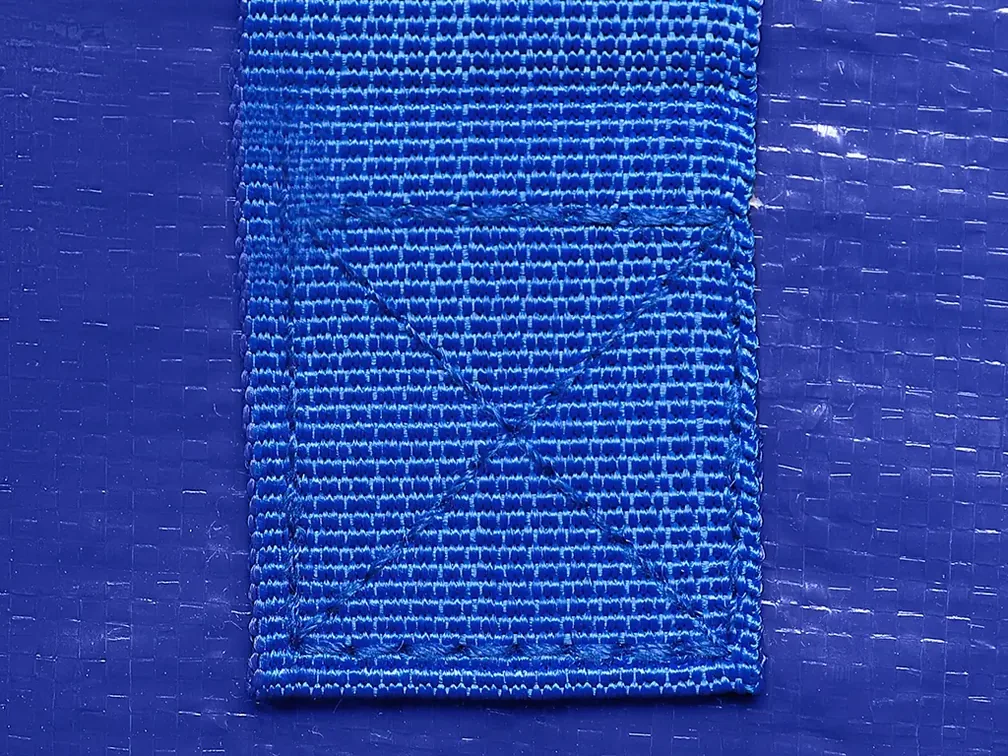
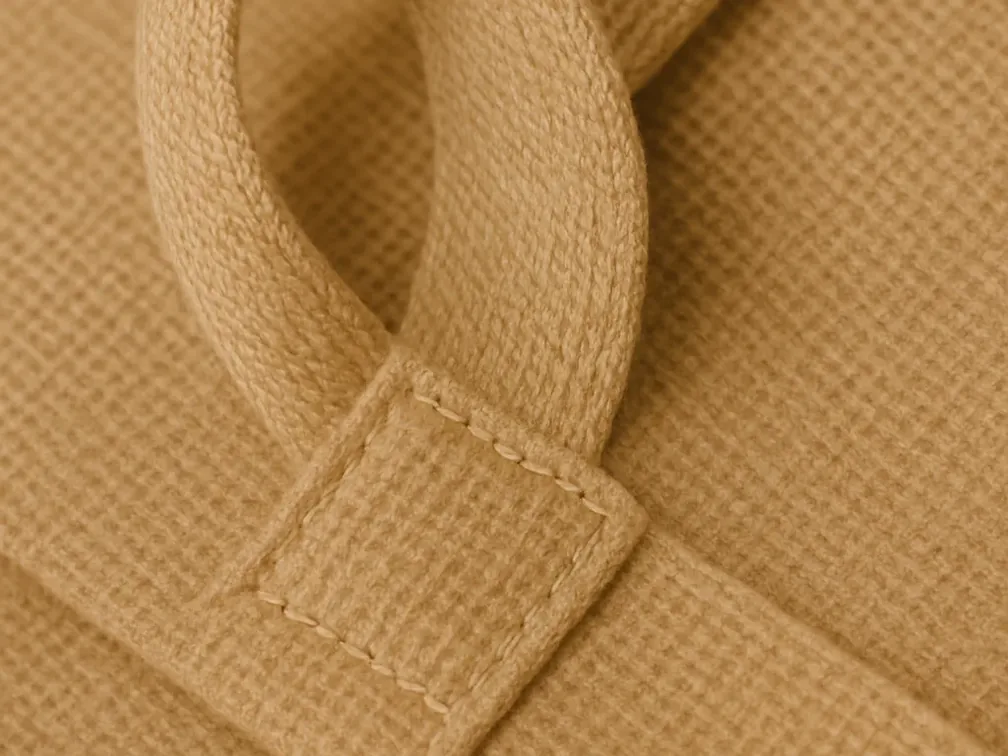
A handle attachment concentrates the load into a few inches of seam, which is why the thread grade and the stitch density there are a specification rather than a detail. Our own bench shows the same thing. The handle attachment on a tarp bag is reinforced with a cross stitch, and the bottom corner of a finished bag carries double-stitched seams. Where a single row runs across the handle base, the seam has one row to fail instead of two.
The webbing should also run the full length of the bag rather than only under the handles. Thread is only as good as the fabric it is sewn into, so a seam can hold and still tear the shell when the load is spread across too little cloth.

The Three Thread Families Side By Side
Three thread families cover bag work, and the choice is a trade between strength, abrasion resistance and cost. Bonded nylon carries the highest tenacity per tex of the common bag threads, with bonded polyester close behind at equal size.
| Family | Load per size | Abrasion | Where it fits |
|---|---|---|---|
| Bonded nylon | Highest tenacity of the three | High, and the bond helps | Handle bases, bottom seams, any seam handled daily |
| Bonded polyester | Close to nylon at equal size | High, plus UV and mildew resistance | Outdoor and food-adjacent programs, washed goods |
| Cotton-covered polyester | Lower, so it stays off load seams | Moderate at the sheath | Light and medium bags where a matte look matters |
The third family explains most of the confusion in a sample review. Cotton-covered polyester sits flat against soft fabric and reads natural under print, but it gives up tenacity and abrasion resistance, so it belongs on a light bag rather than on a load-rated seam. The fabric sets the frame for the choice, since a soft shell does not hold a heavy thread the way a woven shell does.
What A Ticket Size Actually Tells You
A thread label carries two numbers, and buyers confuse them more often than any other line on the sheet. Ticket size is a series number such as T-40, T-60, T-69, T-90 or T-135 that maps to a diameter band, and higher numbers mean heavier thread. Tex is the linear density number behind that band, so a T-69 ticket typically corresponds to roughly 69 tex.
For heavy bags the practical band runs from T-60 on a light drawstring channel up to T-135 on load-rated bottom seams and handle wraps. Dropping below the specified ticket size on a load seam is the common silent substitution in production, because thinner thread sews faster and is easier to buy.
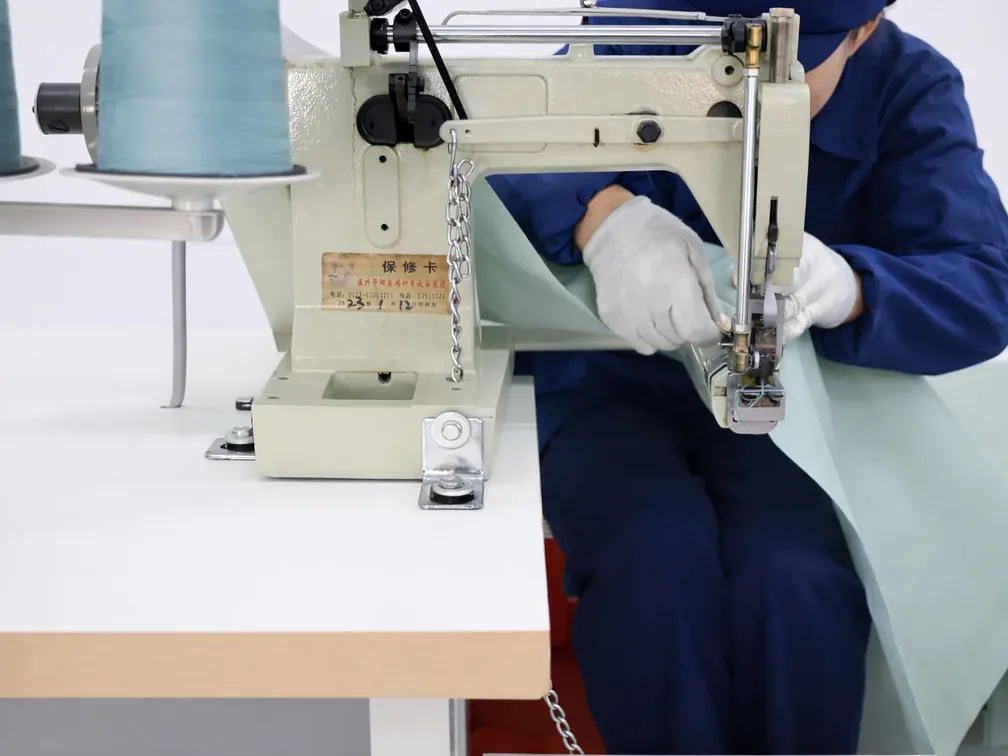
Channel stitching carries a drawstring load in tension, so the thread grade there is part of the functional spec rather than a finishing choice. On our floor the machines carry large thread spools as part of the build, which is how a spec written at the bench survives a change of shift.
Bonding, Finish And What It Stops
Bonding is the finish that keeps a heavy seam alive. Raw twisted nylon or polyester abrades against the needle, the fabric and itself, so bonded thread is passed through a resin or silicone bath and cured until the plies are fused and the surface runs smooth.
The practical difference shows up on the machine and on the road. Bonded thread survives high-speed sewing without fraying, keeps tension consistent at the needle and resists the chafe of a loaded bag rubbing against a truck floor or a shelf. Silicone-bonded finishes add lubricity for difficult fabrics, while wax-dressed cotton-covered threads suit softer goods.
Bonding is not free, but the cost is small against a seam failure that writes off the whole unit.
- Resin bonded: a hard, smooth surface built for high speed sewing.
- Silicone bonded: added lubricity for difficult fabrics.
- Wax dressed: the softer finish for cotton covered thread on light goods. A bag can be built to a stated load and still carry no weight mark on the shell, because the HSE guidance on labelling loads sets out that there is no specific duty on suppliers to mark weights. That is why the weight record is a document you ask for rather than a print you look for.

Questions Buyers Ask About Thread
Which thread carries more load at the same size?
Compare tenacity at an equal ticket size on the lot record, because a heavier ticket can hide a lower grade of thread. The strength band behind the spool is the number to compare.
What does T-69 mean on a label?
The T number is a diameter band, not a strength grade. Two spools with the same ticket can carry different tenacity, which is why the strength band belongs on the same label.
Can a factory substitute a different thread size?
It happens, and it is hard to see, because a T-90 spool and a T-60 spool look alike once they are on the machine. Make the ticket size a named line per seam, and treat any change as a new sample.
Why do heavy seams need bonded thread?
Because a naked thread frays at the needle and chafes against itself inside the seam. Bonding fuses the plies, so the thread keeps its tension and its surface through a loaded move.
What to Would Write In The Thread Spec
Six lines belong in the spec, and each one closes a different hole.
- Material: bonded nylon or bonded polyester, named, with the bonding type.
- Ticket size per seam: one size for main panels and bottom seams, another for handle wraps.
- A strength band, so a substitute spool cannot drop below the load rating.
- Colour fastness, because a thread that bleeds ruins an otherwise clean print program.
- Stitch density in stitches per inch per seam type, since density as well as thread size decides seam strength.
- Verification, with a lot record checked against an independent seam test on the production fabric.
The same six lines are what a sample review should read in order, and a spec missing one of them leaves that hole open for the run.
No regulation hands you a seam figure to copy. The HSE manual handling guidance is plain about it:
The weight of a load is important, though the law does not set specific weight limits.
Health and Safety Executive, Manual handling at work
So the load goes into the spec as an agreed number, and the thread spec is what makes that number repeatable on every seam of the run.
How To Check Thread On A Sample
Four checks settle a thread spec on a sample before a bulk run starts.
- Pull the stitch row at the handle base and look at the thread, not the print, because the seam carries the load.
- Count the stitches over one inch and write the count into the spec beside the ticket size.
- Name the ticket size per seam, and put a re-test clause in the contract in case the mill proposes a change.
- Ask for the lot record with the seam test on the production fabric, then keep the reading with the sealed sample.
Our own line answers the same four checks on every order, through 4 checkpoints that end with the finished bag rather than the fabric. The stitch row is inspected in close up, the inspection on a bulk run covers stitching durability, and the durability test tells you how the seam behaves after the tenth trip rather than the first.
For the parts that surround the seam, the moving bags supplier page covers the spec sheet a batch is measured against, the custom tote bag quality checks walk the checks that separate a sample from a run, and the moving bag zipper repair page covers the other closure a crew leans on.