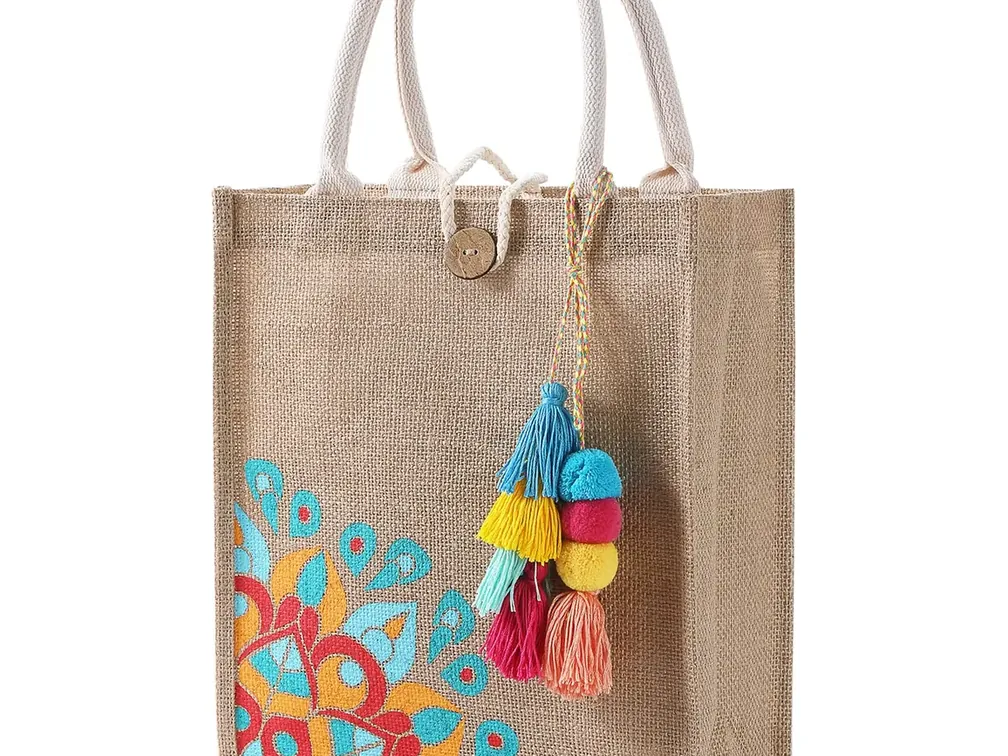
Sublimation dyes polyester and leaves no film, so the colour has no edge to lift; heat transfer film sits on the surface, covers cotton and jute, and ages from the edge inward after 30 to 40 washes. Choose the route by the shell first and by the wash cycle the bag will really see second. A strike off on the actual fabric, washed three times, is what approves the print.
Two tote samples sit side by side, one with a dye that has gone into the cloth and one with a film that sits on top, and the question is which route, sublimation vs heat transfer, survives a returns window.
The question keeps coming up because both routes are described as a print, when one is a dye inside the fibre and the other is a layer on the surface that has an edge to fail from.
How each print bonds to the bag
Two mechanisms sit behind the 2 names, and neither is a matter of press pressure alone. Sublimation turns solid dye into a gas that opens the polymer structure and locks inside it, so the print becomes part of the yarn rather than a layer on it. Heat transfer carries a pre printed film with its own adhesive layer, and that adhesive layer is the part that ages.
That difference explains the hand feel buyers notice first. A sublimated polyester panel feels like the same cloth it was, because the surface is still the fibre, while a film transfer adds a physical layer that a thumb can feel across the print. On a bag that is folded at the gusset, that layer is also the part that creases first.
The two routes also start from different input. Sublimation needs polyester or a polymer coated surface, while heat transfer film runs on cotton, canvas or a blend.
Sublimation and heat transfer side by side
One full colour logo on one bag can be run four ways, and the values that separate them are substrate, heat, dwell, hand feel and wash life rather than a preference.
| Route | Substrate | Heat | Dwell | Hand feel | Wash life |
|---|---|---|---|---|---|
| Sublimation | polyester or a polymer coated face | 190 C | 40 seconds | none, the fibre itself is dyed | 60 washes |
| Heat transfer film | cotton, canvas or a blend | 150 C | 18 seconds | a film layer across the print | 30 to 40 washes |
| Digital transfer paper | cotton and canvas | 165 C | 25 seconds | soft with a slight coat | 40 washes |
| Screen print | cotton, canvas and jute | 160 C cure | 2 minutes per colour | a thin ink film | 50 washes |
The wash column is the one buyers read first, and it is also the one that needs a test behind it. The other 3 routes on the same table are worth naming: digital transfer paper runs at 165 C for 25 seconds, screen print cures at 160 C with 1 screen per colour, and direct to garment prints and cures in place at 90 seconds per piece.
What the wash numbers actually mean
A wash figure is not a property of the ink alone, because the same print on two shells gives two results. Sublimation survives 60 washes on polyester, and a heat transfer film holds 30 to 40 before the edges lift.
The number also depends on what counts as a wash. A printed bag test follows a laundering method with a stated cycle, and the laundering method itself is what the figure refers to:
The colour loss and staining resulting from desorption and/or abrasive action in one single (S) test closely approximates to one commercial or domestic laundering.
The second failure mode is rubbing rather than water. A film edge that fails in a tote is usually a rub and stain result on the handle or the fold, which is why the rubbing method behind a print grade is worth reading beside the wash test.
Press the two together and the practical rule is simple: ask which test the figure came from before you compare two suppliers on a wash count.
Which method fits which shell
Cotton canvas rules out sublimation, and polyester rules out the more forgiving transfers, so the shell narrows the route before a print file is opened. A cotton canvas order sent to a sublimation press comes back faded within about five washes, and a polyester bag sent to a film transfer lifts at the edge inside the first month.
For a cotton canvas tote, screen print or a digital transfer paper give the longer wash life, and a screen print is laid as a thin ink film cured at 160 C. For jute, a heat transfer film covers the coarse surface evenly where a screen print would sit in the weave gaps.
Coated and laminated fabrics break the rule, because the coating decides adhesion rather than the fibre underneath, and that is the case that needs a strike off rather than a table.
Questions buyers ask about a printed bag
Can you sublimate a cotton bag?
No. Sublimation needs polyester or a polymer coated surface, and on untreated cotton the dye does not bond, so the print fades within about five washes. A cotton bag needs a film, a transfer paper or a screen.
How long does a heat transfer last on a tote?
Thirty to forty washes for a film applied at 150 C for 18 seconds, and the edges lift first when the pressure falls below 3 bar. Pressure is as much a part of the spec as the temperature.
Does a coated bag take either route?
It takes the route the coating allows, and the coating decides adhesion rather than the base cloth, so a coated bag is the one case where a table cannot answer for you. Order the strike off on the coated panel itself.
Why do two suppliers report different wash figures?
Because the figure depends on the shell, the cycle and the test method, so a 60 wash claim on one fabric cannot be read across to another. Ask for the method and the grade behind the number.
What the strike off tells us
Our view is that the strike off is the specification, and a table only tells a buyer which strike off to order. Press a print on the actual fabric, wash it three times at 40 C with detergent and air dry it, then look for lift at the edge, a crack at the fold line and a colour shift against a grey scale of 4.
The order of that check matters. A strike off pressed on a flat swatch can pass and still fail on the bag, because a curved surface at a gusset or a handle takes print differently from a flat sheet. That is why the print is approved on a sewn bag rather than on a card.
On our line the print route is named in the same spec as the fabric and the packing format, so screen print, a woven label and a retail packing line are chosen together rather than one at a time. The bag is then checked with a pull, a seam strength test and a bar tack on every batch, which is the part a wash table cannot show you.

What to approve before the run
Five checks settle a printed bag before the bulk run, and the first three take one working day.
- Name the shell and the print route in the same spec line, so the fabric choice and the print choice cannot drift apart.
- Order the strike off on a sewn bag, not on a flat swatch, and keep the approved piece as the reference.
- Wash the strike off three times at 40 C and grade the edge, the fold and the colour shift.
- Confirm the print file against the substrate, because a full colour photo needs a different route from a two colour logo.
- Check the finished bag for pull, seam strength and bar tack before the carton is sealed.
Our fabric range compares PE, PP woven, non-woven, polyester, nylon and canvas on print result, so the shell decision and the print decision are made on one sheet rather than in two conversations. A sewn bag needs no tooling, so a new pattern takes one sample round, and the strike off travels with it. Four checkpoints are photographed for the buyer file on every order, which is how a print approval survives past the first run.
If the next question is how the print is judged on a bulk run, How Do You Run Custom Tote sets out the checks, and How Many Colors Can You Print covers what a full colour logo does to the route.