

Built from a distributor case file and the tote spec fields behind a standard pick and pack program.
A buyer for a medical supply distributor sent over a purchase order last month with one line highlighted: the tote size. Her warehouse had four picking lines and four different totes, and she wanted to know which single size could replace them all. The order form had a column for dimensions and nothing else, which is how most tote specs begin and how most of them go wrong.
That single line, the one that says 40 by 30 by 9.8 in or whatever number the buyer carries over from the last order, is doing far more work than it looks. It decides whether a picker stops to think, whether a carton ships oversized, and whether an order arrives whole or split into two. The rest of the spec sheet is where a distributor either locks that decision down or leaves it to the floor to improvise.
The Order Line That Started the Standard

The line on that purchase order read like a size and nothing more. It gave a length, a width and a height, then moved straight to quantity and colour. There was no note on the base, the handle, the closure or the label, so the factory would have built to the number and filled the gaps with whatever the sample room had on hand.
That is how a distributor ends up with a tote that works on one line and fails on another. A picker on the small-parcel line finds the bag too deep to reach the bottom, a picker on the bulk line finds it too shallow for a full order, and each one adapts in a different way. The adaptation is invisible on the order form and very visible in the pack.
A standard tote is a procurement call and an operational call at the same time. The spec sheet is the only place both calls get written down before the factory cuts fabric.
Sizing the Tote to the Largest Common Order

The size line should be set against the largest common order, not the average one. An average-sized tote fits most picks and forces a split on the heavy tail, and the heavy tail is where the re-picks and the extra cartons live. Sizing to the largest common order means the routine order fits with room to spare and the rare oversized order is the only one that splits.
Write the size as internal dimensions, not external. A 40 by 30 by 9.8 in tote measured on the outside loses two to three centimetres to the shell and the base panel, and that loss is enough to change whether a boxed item drops in flat or has to be angled. State the tolerance too, because a bag sewn two centimetres narrow still passes a casual glance and fails a picker on a timed line.
Verification starts with a physical check against a known load. The sample room fills the approved size with the heaviest common order mix and confirms the contents sit below the rim, so the tote can be closed and stacked without crushing anything. A tape measure alone will not catch a base that bulges under load.
The line most buyers leave blank here is the one that says what happens when an order exceeds the size. A standard tote needs a stated split rule, so a picker knows an oversized order becomes two totes rather than one overfilled bag. Without that rule the floor invents its own, and the pack stops being standard.
Base, Handle and Webbing: What Holds the Load
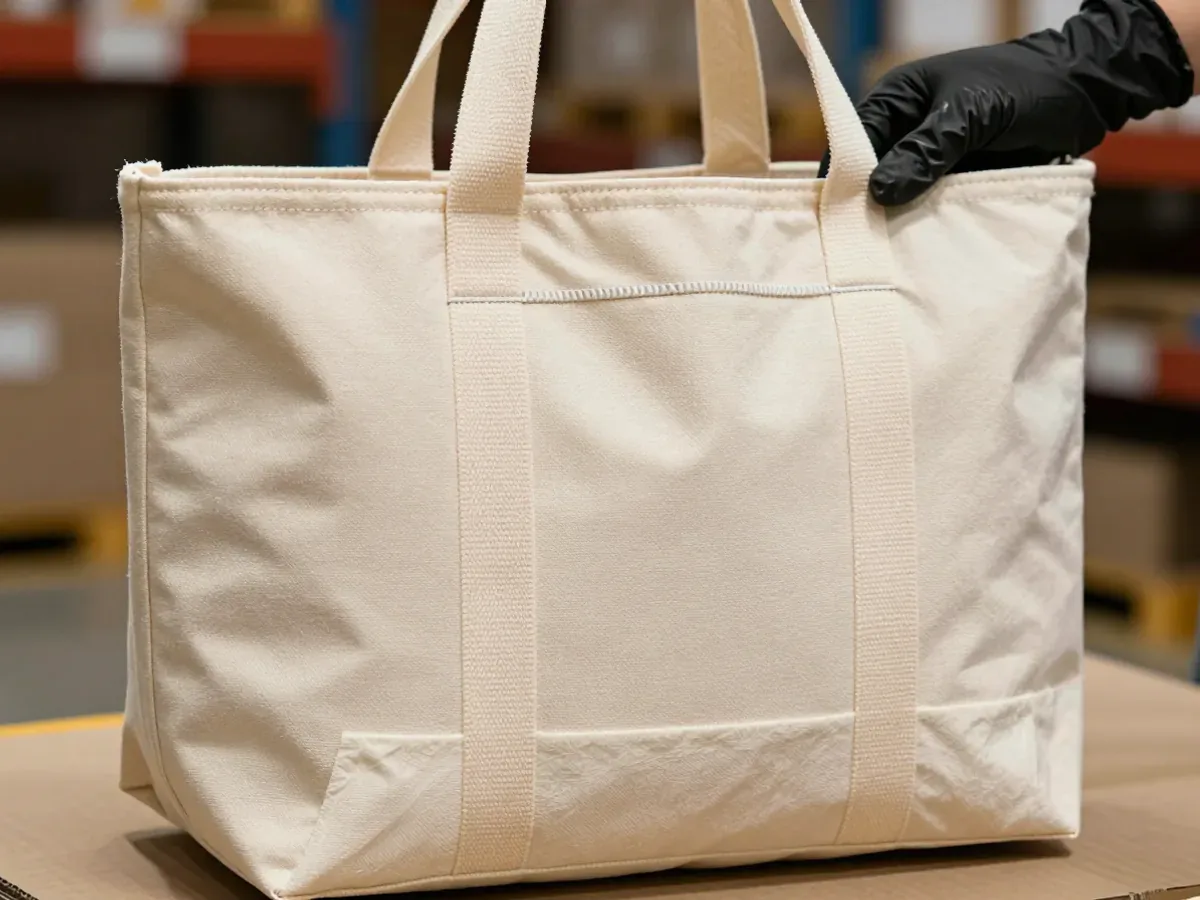
A stable base is the difference between a tote that stacks and a tote that leans. The base panel should be reinforced so a full bag holds its footprint when set down, and the seam that joins base to shell should be the first thing checked on a production sample. A base that sags under a full medical order tips the stack and slows the pack station.
The handle spec needs more than a length. Wrap-around webbing that runs the full length of the bag, rather than stopping at the handle roots, spreads the load into the shell instead of pulling on two stitch points. That construction detail belongs on the spec sheet as a sentence, because a factory that reads only "two handles" will build the cheaper version.
Verification for handles and webbing is a pull test on a finished bag plus a visual check of where the webbing terminates. The webbing should continue down the body and be caught in a seam, not cut at the handle and bar-tacked. A batch sample opened at the seam shows this in seconds.
The Label Pocket That Replaces a Look Inside

A clear pocket on the face of the tote lets a card say what is inside without anyone opening the bag. On a multi-line operation that pocket is the difference between a picker reading the order and a picker unzipping four totes to find the right one. The spec line should name the pocket position, its clear material and the card size it accepts.
Write the pocket as a face-mounted pocket with a clear front, sized to the warehouse's own order cards. If the card size is left off, the factory guesses, and a pocket that fits a business card is useless for an A6 pick ticket. The position matters too, because a pocket low on the face disappears when totes are stacked.
Verification is simple and often skipped. The sample room prints a card at the stated size, slides it in, and checks that it reads from a metre away and survives a stack of three totes above it. A pocket that clouds or creases at the fold fails that check.
Shell and Zip: Cleaning, Closing and Reuse
A reusable tote in a medical supply chain gets wiped down between jobs, so the shell has to take a wipe and keep going. The spec should name a shell that wipes clean and state that the same bag returns to service on the next order. A shell that stains or holds moisture turns a reusable asset into a disposable one within a month.
The closure line deserves its own row. A two-pull zip closes the opening from either end, which matters when a picker loads from one side and a packer checks from the other. A single pull forces the bag to be turned, and turning a full tote is how contents shift and labels end up facing the wrong way.
Verification covers the zip run and the shell surface together. The sample is opened and closed across the full length, then wiped at the seam where the zip meets the shell, because that join is where a cheap build fails first. A zip that catches at either end will be left open on the floor.
How Each Line Gets Verified Before the Container Seals
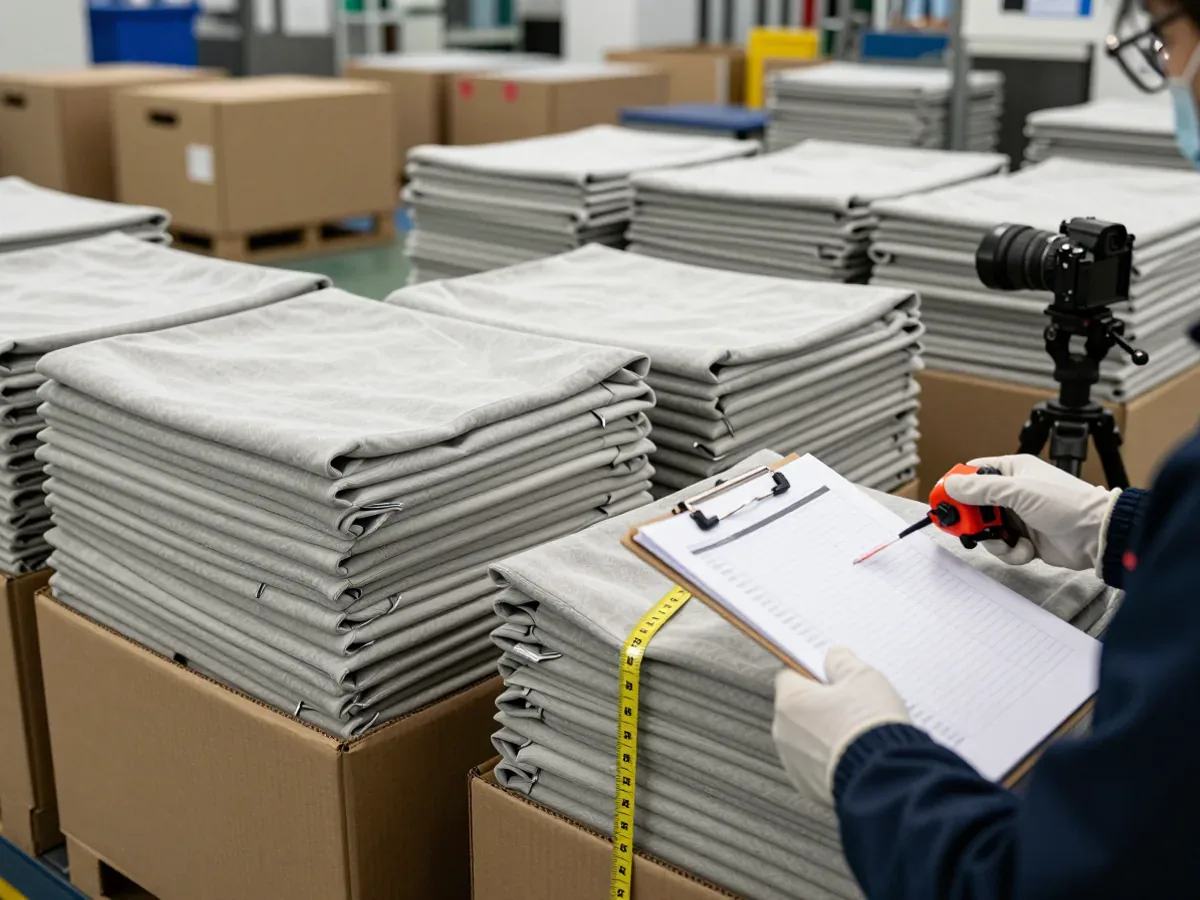
Every batch passes four QC checkpoints, and the spec sheet should map its lines onto them. The checkpoints run from incoming material to the final count, so fabric, webbing, zips and thread are checked against the approved spec before cutting begins. A size line that never reaches the incoming inspection is a size line nobody enforces.
The middle checkpoints cover the sewn bag: dimensions against the stated tolerance, base reinforcement, webbing termination and pocket position. These are the lines that decide whether the standard holds across a batch or only across the first sample. A batch that passes on average but varies by two centimetres is not standard.
The final checkpoint is the count. Cartons are counted and photographed before the container seals, which gives the buyer a record tied to the batch rather than to a promise. Photographs of packed cartons also show whether the totes were folded and stacked the way the spec intended.
The Line Buyers Leave Blank Until the First Split
The line that gets left blank is the split rule. Almost every tote spec names a size and stops, and the first oversized order exposes the gap. A standard tote works because an order either fits or becomes a known number of totes, and that number has to be written before the picker meets the order.
Write it as a sentence on the spec sheet: orders above the stated load or volume split into two totes, packed to the same standard. Add the load limit that triggers the split, so the decision is a number and not a judgment call at nine in the morning. The rule also tells the factory what the tote must survive, since a split order means two partially filled bags rather than one strained one.
Once that line is filled in, the rest of the sheet holds together. Size, base, handle, webbing, pocket, shell, zip and split rule all point at the same operational idea: one tote, one pack standard, one number of totes per order. A distributor that writes those lines once stops rewriting them on every purchase order.
FAQ
Should the tote be sized to the average order or the largest common order?
Size to the largest common order. An average-sized tote fits most picks and forces splits on the heavier orders, which is where the extra handling and cartons come from. The rare order above that size follows the split rule.
How do we verify webbing and handles on a tote batch?
Pull test a finished bag and open the seam on a batch sample to see where the webbing terminates. Wrap-around webbing should continue down the body and be caught in a seam, not cut at the handle root and bar-tacked.
Can one standard tote replace four line-specific totes without slowing pickers?
It can when the size, split rule and label pocket are all specified. The picker stops choosing a tote and starts reading a card, and an order either fits the standard or splits by a stated rule. The speed comes from removing the decision, not from the bag itself.






