Drawing on factory QC records and production-line practice for custom printed tote bags.
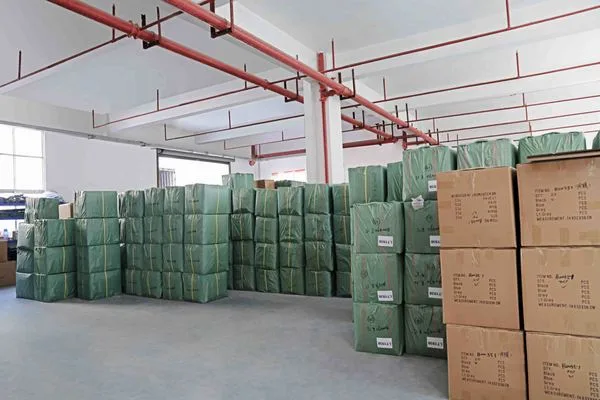
A carton label on the loading bay read "Navy, 500 pcs." The bags inside were closer to slate, and the buyer's print proof, signed three weeks earlier, had nothing to do with it. That moment explains why so many bulk tote bag orders go wrong after everything looks settled.
Most buyers treat a signed print proof as the end of the conversation. The artwork is approved, the sample matched, the deposit is paid. From there the order is supposed to run itself. On a large run, the proof only settles what the design should look like, not whether the factory can hold that look across tens of thousands of impressions and a few hundred sewing stations.
The Approval That Feels Like a Finish Line

A pre-production sample arrives in a courier box, and the buyer opens it on a desk under office lighting. The print looks sharp, the handles feel solid, the size matches the spec sheet. Someone signs the approval form, scans it, and sends it back the same afternoon.
That signature feels like a milestone because it is the last moment the buyer has direct control. After it, the order disappears into cutting, printing, sewing, packing and freight, and the next physical object the buyer sees is a container. The proof becomes the mental stand-in for everything that follows.
The problem is that a proof is a single unit, often made on a sample table with extra care. It proves the design is possible. It does not prove the line can repeat that result at volume, on a Monday morning, on the fourth pallet, with a different operator running the screen.
Why a Signed Print Proof Looks So Convincing
Print proofs are persuasive because they answer the question buyers are most afraid of. Nobody wants to approve artwork and discover the logo is crooked or the Pantone is wrong, so the proof targets exactly that fear. It shows the design rendered correctly, and it closes the loop on the creative decision.
There is also a paperwork effect. A signed proof creates a shared reference that both sides can point to later. If a dispute arises, the buyer can hold up the approved sheet and say this is what we agreed. That feels like protection, and in a narrow sense it is.
What the proof cannot show is drift. It cannot show how the fourth color behaves when the mesh clogs, how the ink sits after a drying tunnel, or whether the seam that held on a sample table still holds when the same stitch is run at production speed for six hours.
Where the Risk Actually Sits on a Large Run
Two failure modes account for most of the damage on bulk printed tote bags, and neither one shows up in a design file. The first is color variation across batches. The second is handle stitching that gives way under load.
Color drift is quiet. A run can start on target and slide half a step by the middle of the day as ink viscosity changes, screens wear, and drying conditions shift. Industry tolerance is commonly stated as delta E of 3 or less, and a shift inside that band can still read as a different shade when two pallets sit side by side on a retail floor.
Handle failure is louder but arrives late. A single-needle stitch may survive a gentle sample pull and still fail in the field once a bag carries books, groceries or a laptop every day for a month. Reinforced double stitching tested to 50 lbs under seam strength methods gives a different margin than a stitch that lets go around 30 lbs.
What a Color Check Should Measure, and How Often

A color check without a number is an opinion. The useful version uses a spectrophotometer to read the printed area against the approved PMS standard and records the delta E for each reading. That turns "looks close" into a value someone can compare across pallets and across days.
Frequency matters as much as method. Checking once at the start of a run confirms the setup, not the run. Measuring every 200 units on the production line catches drift while there is still time to stop, adjust the ink or re-screen, and re-check before the next pallet is wrapped.
The tolerance should be written into the order before production starts. If the accepted band is delta E of 3 and the factory can hold under 1.5, the buyer has room to negotiate a tighter internal target. If a reading crosses the line, the response should be defined too: stop, correct, re-measure, and quarantine anything produced since the last good reading.
How Handle Seams Are Tested Before They Ship
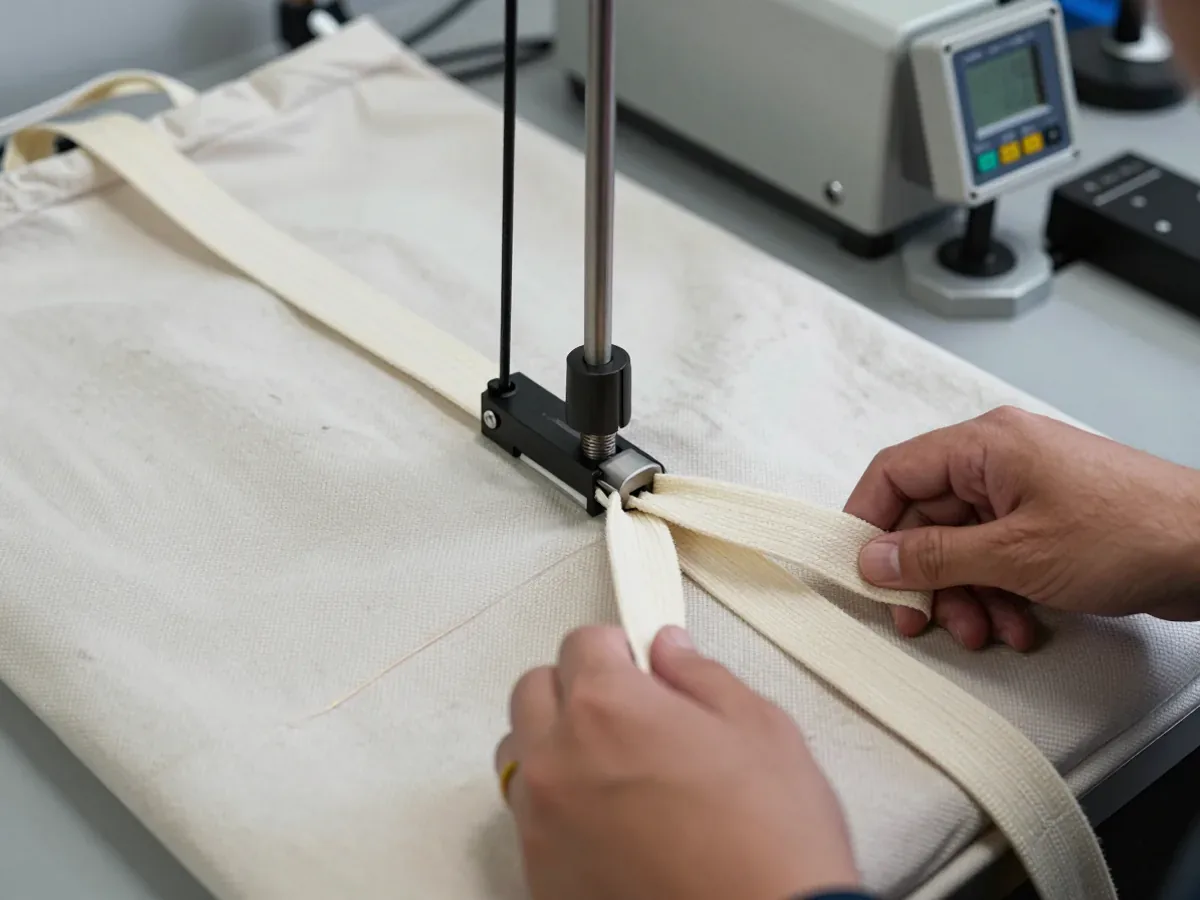
Handle testing is where a spec sheet usually goes vague. "Strong handles" is not a test. A seam strength method such as ASTM D5034 gives the factory a repeatable way to pull a handle to a stated load and record where it fails.
The number to agree on belongs in the purchase order. If the requirement is 50 lbs and a handle fails at 48 lbs, the correct response is not to ship the rest and hope. The machine that produced that handle gets flagged, the output since the last passing test is quarantined, and the batch is re-inspected before it moves to packing.
Stitch density belongs in the same conversation. Handle attachment is often the slowest station on a sewing floor, and that slowness is a signal worth reading. If the factory rushes that station to hit a date, the seam is the first thing to suffer, and the buyer will not see it until a customer sends a photo of a torn strap.
The Carton and Pallet Checks Buyers Skip

Packing is treated as logistics, so it gets less attention than print and sewing. The bags that reach a store, though, are judged in the carton. A polybag protects against dust and moisture, and a retail-ready box with brand-matched print prevents the abrasion that scuffs a printed surface in transit.
Carton labels deserve a direct check before sealing. Size, color name, quantity per carton and total carton count should match the packing list line by line. A mislabelled carton is cheap to fix at the factory and expensive to fix in a distribution center, where the bags may sit while someone investigates.
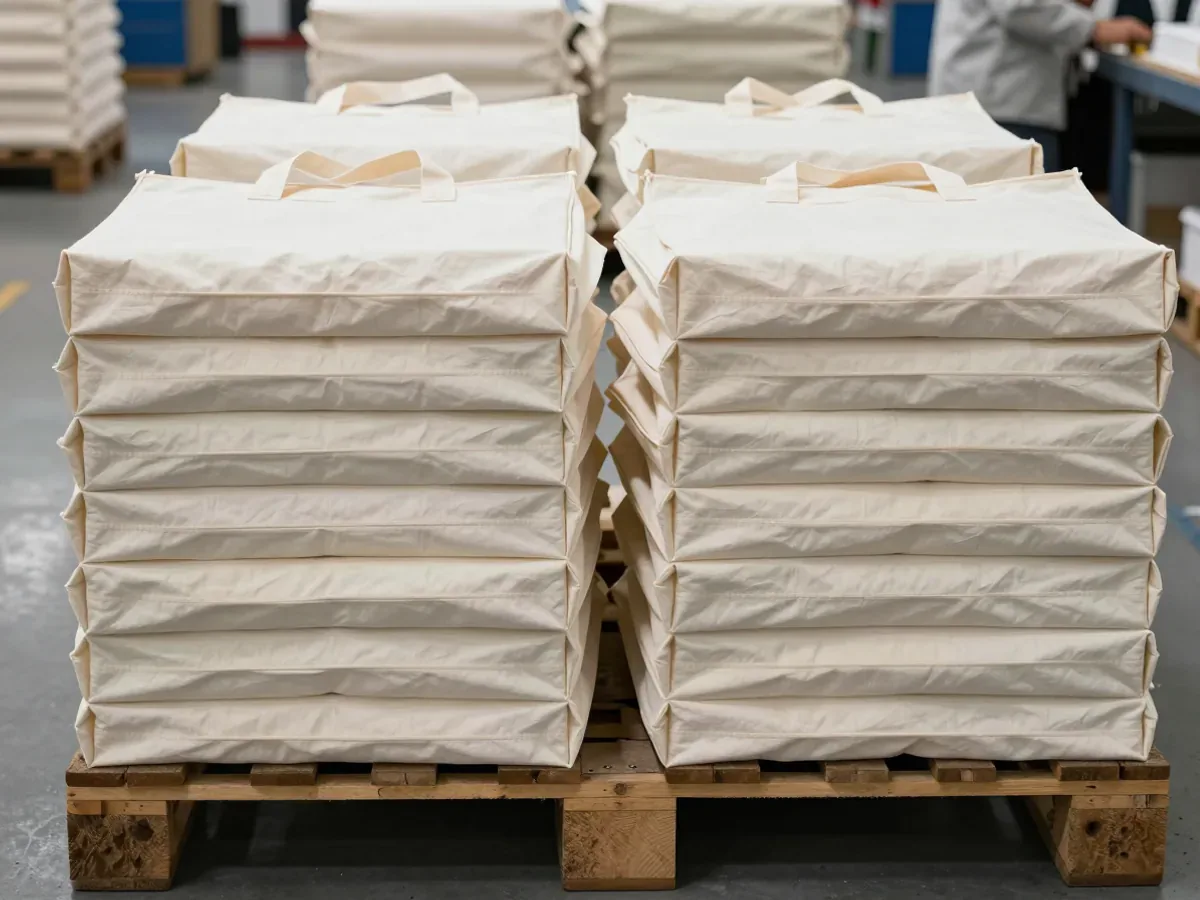
Pallet configuration is the last item. Confirm how many cartons per layer, how many layers, and whether the pallet is stable enough for the freight mode booked. A pallet that shifts in a container turns a clean production run into a claim, and the cause will have nothing to do with the print.
A Short Self-Check Before You Release the Order
Before the deposit goes out, the buyer can run a short list against the order file. Is the color tolerance written as a delta E number, with a stated check frequency and a defined response when a reading fails? Is the handle seam requirement written as a load figure tied to a named test method, with a quarantine rule?
Is the packing spec complete, covering polybag, inner box, carton label fields and pallet pattern? Has someone confirmed which four checkpoints the factory runs and what gets recorded at each one? These are not creative questions, and that is why they get skipped.
The order that arrives as approved is the one where the proof was treated as a starting line. The design decides what the bag looks like. The color readings, the seam pulls and the carton labels decide whether fifty thousand of them look like the same bag.
FAQ
How often should color be checked during a bulk tote bag order?
A practical interval is every 200 units on the line, measured with a spectrophotometer against the approved standard. The point is to catch drift early enough to correct it before a full pallet is packed.
What seam strength should a printed tote bag handle hold?
The figure should be agreed in writing and tied to a named test method. Reinforced double-stitched handles are commonly specified to hold 50 lbs, which gives more margin than single-needle stitching that fails at lower loads.
Does a pre-production sample guarantee the bulk run will match?
No. A sample proves the design is achievable. It does not prove the line can repeat the color and seam result across a full run, which is why in-line measurement and quarantine rules matter.
What packing details should be confirmed before cartons are sealed?
Polybag protection, inner box specification, carton label fields, quantity per carton and pallet pattern. Each one should match the packing list before the carton tape goes on.