
Based on our own tote construction notes and the liner and pocket options we quote on the line.
In the buyer's reference photo, the tote hangs open on a table, and the interior shows a pale grey wall with a single slip pocket stitched low on one side. Two quotes sit beside that photo on the desk: one covers a lined body, the other covers an internal pocket, and they are not the same order. The buyer wants to know which upgrade the photo is actually asking for.
The two documents look close enough to confuse a brief. A liner is a second layer of fabric inside the bag. A pocket is a shaped piece of fabric attached to the inside wall. They solve different problems, they stress different seams, and they are inspected in different places. Treating them as one line item is how a spec sheet ends up describing a bag nobody ordered.
Two Quotes on the Table, One Bag Apart

One quote lists fabric, lining and a soft non-woven layer with removable pads. The other lists a pocket, a zip and a webbing strip. Read quickly, both say "interior upgrade" and both raise the unit cost. Read closely, one changes the whole inside surface of the bag and the other changes one spot on it.
That difference decides what the buyer is really buying. A lined tote carries a defined use because the contents are protected from the bag itself. A pocketed tote carries a defined use because one item has a home. The old framing put both under the same heading of functional upgrades that add margin, which is true and also too loose to order from.
A buyer who signs both quotes without separating them gets a bag with a lining and a pocket, which is a fine product. A buyer who signs one quote believing it covers the other gets a bag that fails the brief on arrival. The rest of this comparison keeps the two apart.
What the Liner Changes About the Bag
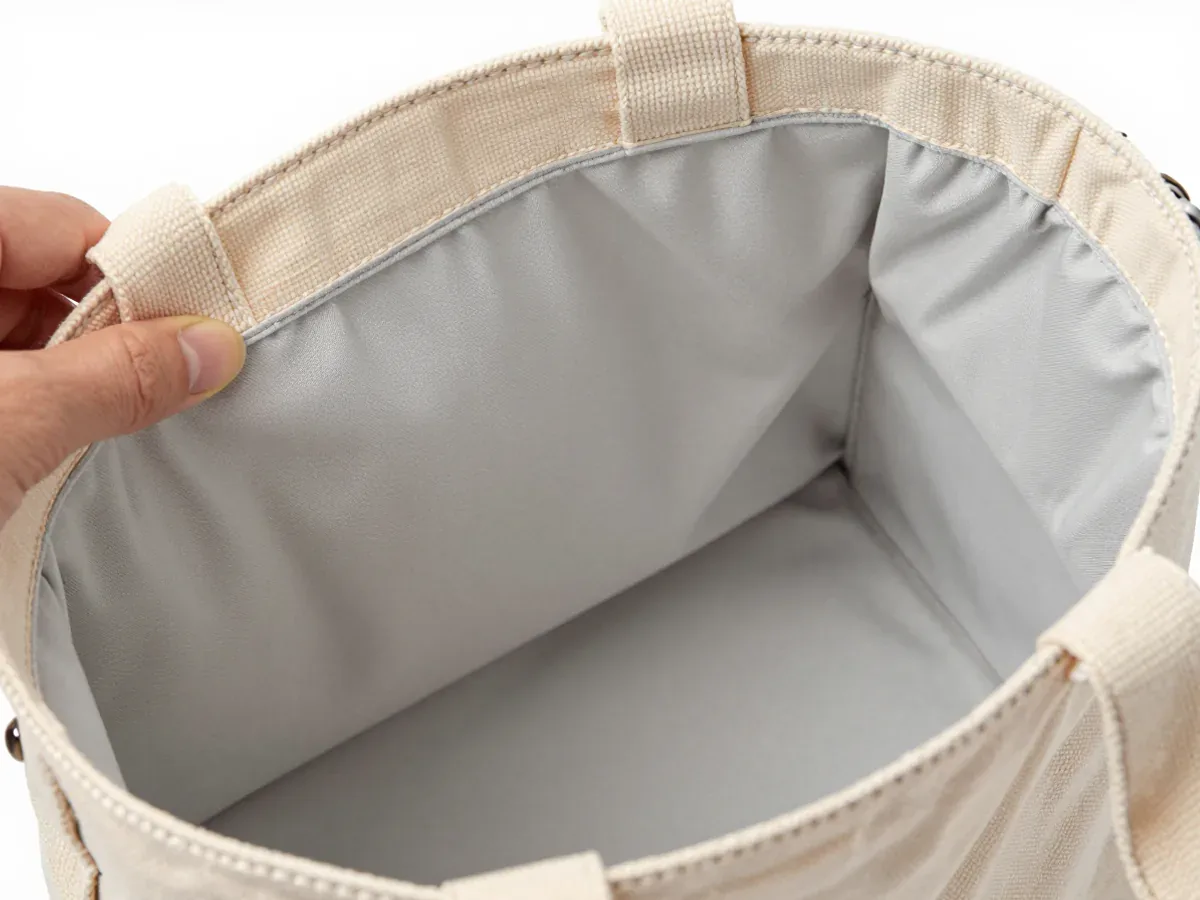
A liner turns the inside of the tote into a finished surface. The raw back of the print, the seam allowances and the base corners all disappear behind a second layer. For a bag that will hold a laptop, a set of documents or a retail purchase, that surface is the difference between a commodity shell and a product with a defined use.
The lining is also where a buyer can make a material statement. A non-woven lining is soft and can be paired with removable pads. An rPET lining is available as an option, which lets the recycled story run through the inside of the bag as well as the outside. Fabric and lining sit together as priority spec items for exactly this reason.
A liner does not change the outside print. Printing is proofed before the run and the sample is made to the same spec as bulk, so the artwork on the face of the bag is settled before the lining question comes up. What the liner changes is weight, drape and how the bag feels when a hand goes inside it.
What the Pocket Changes About the Bag

A pocket is a targeted structure. A laptop sleeve holds a laptop. A bottle pocket holds a bottle, and it needs a reinforced base where the bottle sits. A label pocket sits with the zip and the webbing as one detail group, because those three parts are usually specified together and inspected together.
The pocket does not finish the inside of the bag. The rest of the interior stays as it was, with the same raw seams and the same open volume. That is not a defect. It is a choice about where the buyer wants structure and where the bag can stay simple.
A pocket also creates a load path. A bottle pocket carries weight in one corner, so the base under it has to be reinforced and the seam that holds the pocket has to be stitched to take that pull. A laptop sleeve spreads load across a wider panel but adds stiffness to one wall. Both are structure options, and both are judged by what they hold.
Use: Which One the Buyer Will Notice

Picture the bag in a customer's hands for the first time. With a liner, the hand goes in and finds a smooth wall. The bag feels finished, and the reaction is about the whole object. With a pocket, the hand goes in and finds one shaped slot. The reaction is about a specific item, usually a bottle or a laptop, that now has a place.
That is the first decision dimension. If the bag's job is to protect and present its contents, the liner does the work. If the bag's job is to organise one item among several, the pocket does the work. A gusset or flat-bottom tote already carries a defined volume, so the liner finishes what the shape started.
Retail buyers tend to notice the liner when the bag is opened at the counter. Staff and field buyers tend to notice the pocket when the bag is used all day. The question to ask is who opens the bag first and what they are looking for.
Structure: Where Each Upgrade Puts Stress
A liner adds a seam line around the inside of the bag, usually at the top edge, and it adds weight to the body. The shell has to be cut to take that second layer without pulling at the top hem. On a structured build, handles are stitched through the body, and the lining has to sit clear of that stitch line or the inside will pucker.
A pocket adds a concentrated load. A bottle pocket in particular puts weight into one lower corner, which is why the base carries a reinforcement where a bottle sits. The pocket seam takes the pull, and the wall behind it has to be stable enough not to sag.
The two stresses are different in kind. The liner stress is spread around the top of the bag. The pocket stress is local and directional. A factory that builds both has to plan the seam order so the pocket goes on before the lining closes the interior, otherwise the pocket is stitched blind.
Inspection: What You Check on a Lined Body Versus a Pocket

On a lined body, the check is the inside surface. Run a hand around the top hem and look for puckering where the lining meets the shell. Open the bag flat and check that the lining sits square to the base, with no twist at the corners. If removable pads are part of the build, confirm they seat and release without tearing the lining.
On a pocketed body, the check is the pocket itself. Measure the opening against the item it is meant to hold. Pull gently on the pocket edge and watch the seam and the wall behind it. On a bottle pocket, press the base and confirm the reinforcement is where the bottle sits, not an inch to one side.
A bag with both upgrades gets both checks, and the order matters. The pocket is inspected first because it is stitched to the wall, then the lining is checked around it. Printing is checked on the outside as its own pass, since the proof and the bulk sample were made to the same spec.
Cost: Why the Pocket Quote Moves More Than the Liner
A liner is a predictable line. It adds a known area of fabric, a known seam run and a known amount of handling. Once the pattern is set, the liner cost per bag stays close to flat across a run.
A pocket quote moves because the pocket is a small assembly with its own variables. The shape, the zip, the webbing and the reinforcement each add a step, and a bottle pocket adds a reinforced base that a flat slip pocket does not need. Change the item the pocket is designed to hold and the quote changes with it.
That is why the pocket quote is the one to read line by line. The liner question is mostly about which lining material, including whether the rPET option is chosen. The pocket question is about how many steps the pocket adds and where those steps sit in the sewing sequence.
A Decision Table for the Next Brief
| Decision point | Liner | |
|---|---|---|
| Main job | Protect and finish the interior | Hold one specific item |
| What the buyer notices | The whole inside surface | The slot and what sits in it |
| Structure stress | Spread around the top hem | Local load, reinforced base for a bottle |
| Inspection focus | Inside surface, square to base, pad seating | Pocket opening, seam pull, base reinforcement |
| Cost behaviour | Predictable per bag | Moves with shape, zip, webbing and reinforcement |
| Material choice | Non-woven with removable pads, or rPET | Fabric matched to the item it holds |
| Best fit | Laptop, documents, retail purchase | Bottle, laptop sleeve, label and zip group |
Read the table by row, not by column. A brief that needs both a protected interior and a home for a bottle lands on both upgrades, and the table then tells the factory which check comes first.
What to Put in the Spec Sheet This Week
Write the liner and the pocket as two separate lines, each with its own purpose sentence. For the liner, name the material and state whether removable pads are included. For the pocket, name the item it holds and give the opening size, then state that the base is reinforced where a bottle sits.
Add the seam order to the technical note. The pocket goes on before the lining closes the interior, and the inspection plan should follow that order. Keep the print proof and the bulk sample on the same spec so the outside check stays independent of the inside work.
Then decide, in one sentence, whether the bag needs one upgrade or both. A tote with a liner and a pocket is a coherent product when the brief says why each one is there. A tote with one upgrade chosen by accident is the order that comes back.
FAQ
Can a tote have both a liner and an internal pocket?
Yes. The pocket is stitched to the inside wall first, then the lining closes the interior around it. The build order matters more than the combination.
Does a lining change the print on the outside of the bag?
No. Printing is proofed before the run and the sample is made to the same spec as bulk, so the outside artwork is settled separately from the lining decision.
Why does a bottle pocket need a reinforced base?
A bottle puts weight into one lower corner. The base carries a reinforcement where the bottle sits so the pocket seam and the wall behind it take the pull without sagging.
Is an rPET lining available for a lined tote bag?
Yes. rPET is an available lining option alongside the soft non-woven lining with removable pads.






