

Based on legacy TIIOCTI notes on tote bag tear-out strength, the 150 load cycle test and ASTM D5034 grab test reporting.
On dispatch day, a carton of tote bags came off the pallet and the handle of the top unit tore out at the seam before the container door was even closed. The loader set it aside, and the same bag was photographed on the floor with its webbing hanging loose. That single failure was the first line on a bill the buyer had not yet learned to read.
The quote on that order looked clean. The bag price per unit was low, the freight was standard, and the delivery window fit. What the quote did not show was the cost of a handle that lets go at the seam after a few dozen lifts. A cheap tote bag hides its real cost in four places, and only one of them appears on the invoice.
The Four Lines on the Bill After One Handle Pulls Out

The first line is replacement. A failed bag has to be swapped, and the swap carries a unit cost plus the freight to restock it. That number is visible and easy to budget.
The second line is labor. A warehouse crew member stops, repacks the load, and disposes of the torn bag. That time is paid whether or not anyone writes it down.
The third line is a damage claim. When a seam gives way in transit, the contents spill and a retail partner files a claim. One claim can erase the savings from a whole quarter of cheap bags.
The fourth line is the repurchase cycle. A bag that fails early forces the next order sooner, and that shortens the window in which the original low price was supposed to pay for itself.
Replacement Is the Smallest Number on the Page

Replacement is the line buyers see first, and it is usually the least expensive. A torn bag is a known unit, and a known unit has a known price. The trouble is that this line is also the one that gets measured, so it becomes the whole conversation.
Labor and downtime are larger and softer. A crew that handles a failure loses minutes per incident, and those minutes stack across a shipment. Nobody invoices them, so they never enter the comparison between two suppliers.
Damage claims are larger still, and they arrive late. A claim from a retail partner can land weeks after the container ships, long after the purchase decision was closed. By then the cheap quote has already been booked as a win.
Why the Failure Shows Up at 60 to 70 Percent of Rated Load

A handle rarely fails at the peak load printed on a datasheet. It fails at 60 to 70 percent of rated capacity, after 40 to 50 cycles, because the attachment was never built for repeated stress. The bag held the weight once, and that single pull told the buyer nothing about the fiftieth lift.
Warehouse handling is cumulative. A forklift jerks the bag off a pallet, a packer overstuffs it until the zipper bulges, and the bag gets dragged and tossed. Each event is small, and together they work the handle seam until the bar-tack gives.
This is why a static burst number can look strong and still mislead. A bag rated at 300 lb in a one-time pull can fail after 50 load cycles. The peak number describes a moment, and the failure lives in the repetition.
What a 150 Cycle Report Adds to the Cost Math

A 150 load cycle test at 150 lb static load per handle measures handle fatigue and seam durability under repeated stress. It does not measure fabric burst. That distinction matters because the handle seam is where the cost hides.
When a bag survives 150 cycles at that load, the repurchase cycle stretches. Instead of buying every 8 to 10 months, the same fleet can run 18 to 24 months. The unit price barely moves, and the fourth line on the bill collapses.
A bag that clears the cycle test typically outlasts three standard units in freight use. Put that against the replacement, labor, and claim lines, and the cheap bag stops looking cheap. The report is a cost document as much as a strength document.
Reading the Report: Cycle Count, Failure Mode, Sample Size
A report that states only a maximum load, with no cycle count, is a strength report and not a durability report. Those are different documents, and only one of them predicts what happens in a warehouse aisle.
Failure mode matters just as much. A supplier may list a pass without saying whether the test stopped because the bag still held or because the handle tore out at cycle 147. The second version is the one a buyer needs to see.
Sample size is the third check. A single bag can be a statistical outlier, so a minimum of five samples per test gives the result some repeatability. A report showing n=1 invites the question of whether the best bag was chosen for the photo.
Method is the fourth check. A report citing a hand pull test or an internal method, with no ASTM or ISO reference, cannot be compared to anything. For woven polypropylene, ASTM D5034 is the grab test that measures tear propagation directly. A seam slippage test measures fabric movement at the seam, which is a different question.
Bar-Tack Density as a Line Item in the RFQ
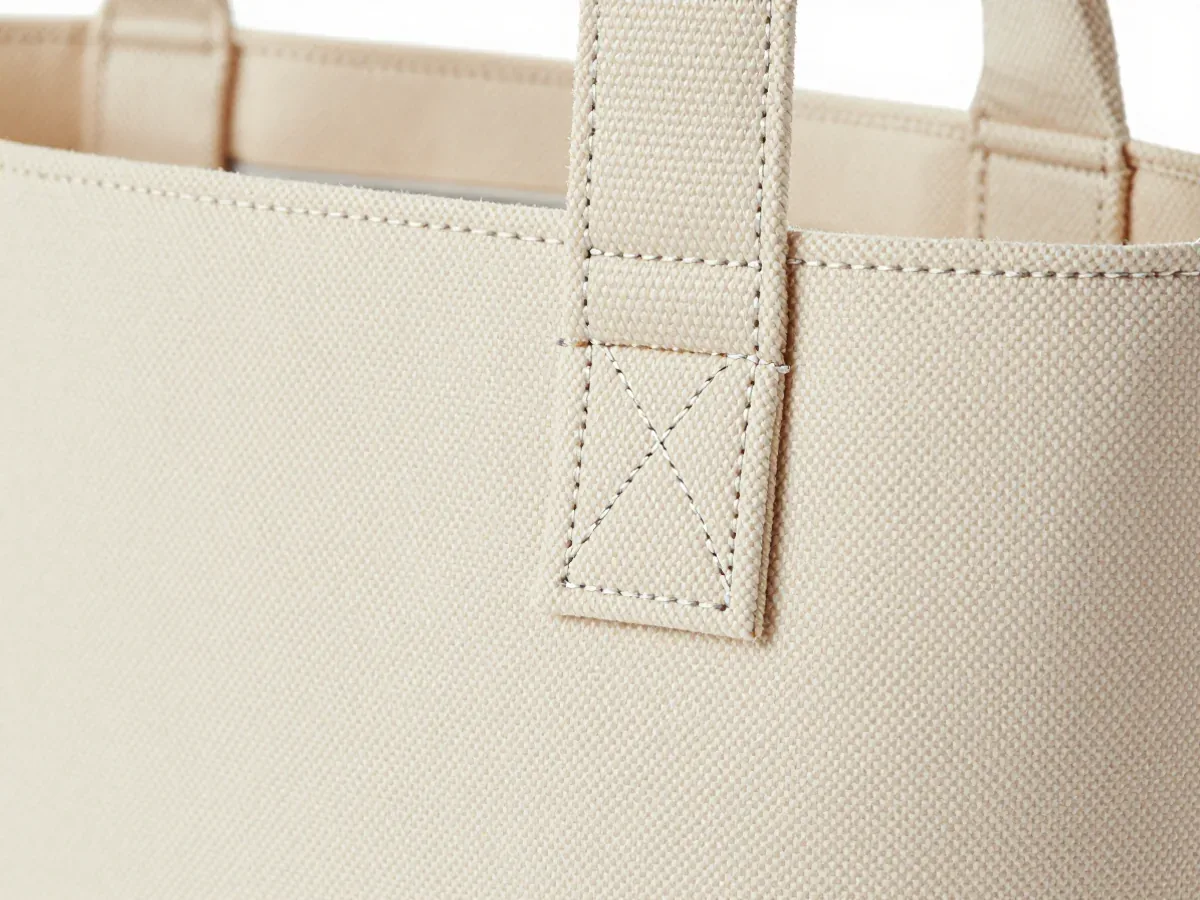
Bar-tacking at the handle-seam intersection often decides tear-out resistance more than fabric GSM does. A 200 GSM bag without bar-tacks can fail earlier than a lighter bag with proper reinforcement. Cheap suppliers skip the step because it adds time per bag, and the saving shows up in the quote.
That is why bar-tack stitch count belongs in the RFQ next to GSM. Ask for the count, not just the fabric weight, and ask for magnified photos of the seam intersection. The bar-tack should be visibly distinct from the main seam.
Our own handle uses an X stitch at the attachment, and the moving bag handle is wrapped and double stitched. Those details are checkable, and a supplier who cannot show them is asking the buyer to trust a number instead of a build.
What to Put in the Spec Before You Approve the Order
The spec should name the test, the load, the cycle count, and the failure mode. A line that reads "passed 150 load cycle test" without those four parts leaves the buyer unable to compare one quote to another.
Ask for both a static load figure and dynamic tear resistance, because the two answer different questions. Then ask for a short video of the handle under cyclic loading, not a still photo. Ten seconds of load and release shows more than a page of peak numbers.
Before approval, confirm the sample count and the method reference. Five samples and ASTM D5034 give the report a floor. Anything less is a claim, and a claim is not a cost model.
FAQ
Does a 150 load cycle test replace a static burst test?
No. The cycle test measures handle fatigue and seam durability under repeated stress, while a static burst test measures a one-time break point. A useful report carries both, because each answers a different question about the bag.
How many samples should a tear-out test report include?
A minimum of five samples per test gives the result repeatability. A single bag can be an outlier, and a report showing n=1 raises the question of whether the best unit was selected.
Why does ASTM D5034 matter for woven polypropylene totes?
It is the grab test that measures tear propagation in woven PP. A seam slippage test measures fabric movement at the seam instead, so it does not describe what happens at the handle attachment.
What bar-tack detail should go into the RFQ?
Ask for the stitch count at the handle-seam intersection, alongside GSM, plus magnified photos showing the bar-tack as distinct from the main seam. A supplier who skips the reinforcement is saving seconds per bag and shifting the cost to the buyer.






