
This comparison draws on our archived waterproof backpack and duffle notes plus first-hand construction records from our own bag line.
Six bags came back from a single rafting week, and five of them were backpacks. The returns sat in a warehouse corner for two months before anyone opened them, because the trip operator assumed the problem was the fabric. When the cartons were finally unpacked, the fabric was fine on every one. The failures were in places the spec sheet never described.
That delay matters. By the time the bags were inspected, the operator had already reordered the same model, and the second batch was on the water. A format decision made on capacity numbers alone had turned into a repeat purchase before anyone understood what had actually broken.
Six Bags Came Back From One Rafting Week
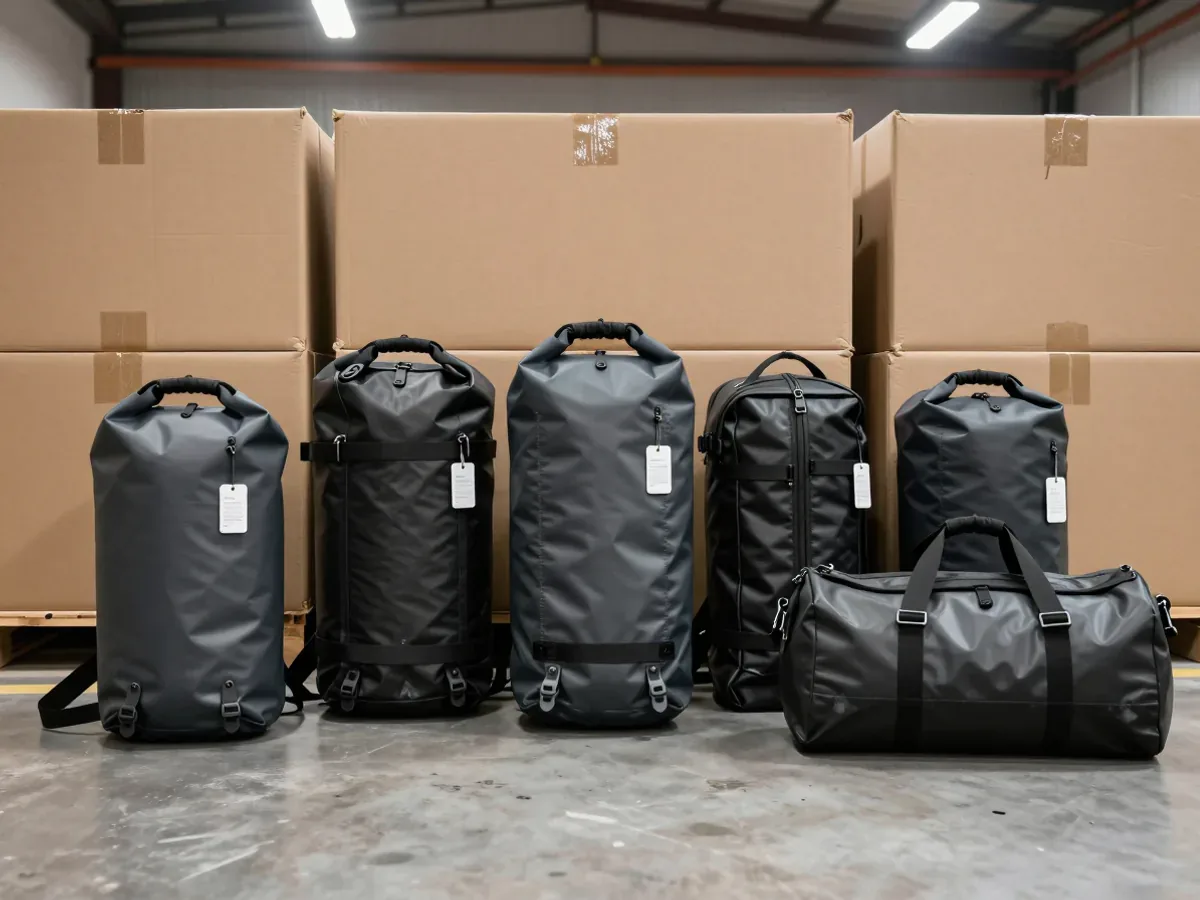
The trip was a five-day river run with two portages and a wet landing every afternoon. Clients carried their own gear from the put-in to the rafts, then from the rafts to camp. The operator had ordered forty waterproof backpacks at 40L and twenty waterproof duffles at 60L, split by what each client was told to bring.
The returns came back with three different complaints written on the tags. Two backpacks had wet sleeping bags inside. One had a soaked first aid kit. Two more had torn strap anchors where the bag had been dragged across rocks. The sixth return was a duffle with a broken handle attachment, and that one turned out to be a different problem entirely.
What the tags did not say was where the water entered. That took a hose test in the workshop and a careful look at the seam construction on each returned unit.
Tracing the Returns Back to the Brief
The brief for this order was one page long. It listed capacity, colour, logo placement, and the phrase “fully waterproof” in bold. There was no line describing how the bag would be carried, how far, or over what ground.
That gap is where the format decision went wrong. A 40L backpack and a 60L duffle were treated as two sizes of the same product. In use they are two different carrying systems, and they fail in different places under different loads.
The operator had chosen backpacks for clients who would walk between stops and duffles for clients who would mostly stay near the rafts. On paper that split makes sense. On the river, every client walked, and the duffle carriers ended up shouldering a single-strap load for the portages.
The Seam That Was Stitched, Not Sealed

The hose test on the returned backpacks found water entering at the bottom seam and at the base of the front pocket. Both were stitched seams. A stitched seam is not a sealed seam, so a woven shell resists splashes rather than water. Once the bag sat in the bottom of a raft for an afternoon, the difference showed up as a damp sleeping bag.
The duffles in the same order used welded seams on the main body. Water beaded and ran off. The one duffle that came back had failed at a handle, not at a seam, which is a load problem rather than a waterproofing problem.
Buyers miss this when they compare formats by capacity. A duffle with a simple open body and welded construction has fewer entry points than a backpack with pockets, dividers, and a zip running down the front. The backpack can still be made watertight, but every extra seam and closure is a place that has to be engineered, not just sewn.
Why the Duffle Held and the Backpack Did Not
The duffles held because their job was simple. Gear went in, the roll top closed, the bag sat on the raft or in the truck. The load was carried short distances by two people or one person using padded carry handles and a detachable shoulder strap.
The backpacks were asked to do more. They carried the same wet gear on a client’s back for an hour at a time, over uneven ground, with the bag set down in water at every landing. The padded shoulder straps and chest buckle spread the load across the back, which is what they are designed to do. What they could not do was keep a stitched base seam dry through repeated immersion.
Format and journey have to match. A backpack is built for mobility and organisation across multiple stops. A duffle is built for volume and rugged protection when the bag is mostly handled rather than worn. The rafting week needed both, but it needed them assigned to the right legs of the trip.
What the Carry System Did Under Load

The two torn strap anchors told a separate story. Both failures happened at the point where the shoulder strap met the body of the bag, after the bag had been dragged rather than lifted. Handles run as woven tape or webbing and are stitched through the body, and that stitching is only as strong as the reinforcement behind it.
On the duffle side, the broken handle had been wrapped and double stitched, and it still failed. The load was simply heavier than the attachment was built for, because the duffle had been packed to its full 60L with wet gear.
A padded back panel and a chest buckle help spread a load across the back, but they do not change what the attachment points can take. Buyers comparing formats often look at strap comfort and skip the anchor construction. On a wet trip, the anchor is what decides whether the bag comes home in one piece.
The Spec Lines That Would Have Caught It
Four lines were missing from the original brief, and any one of them would have surfaced the problem before production.
The first was a seam line: main body seams welded, pocket seams stitched and taped, or all seams welded. The second was a carry line: maximum carried weight and the expected carrying duration per leg. The third was a handling line: whether the bag would be dragged, lifted, or strapped to a raft. The fourth was a closure line: roll top only, or roll top plus a secondary zip.
None of these are exotic specifications. They are the lines that describe how the bag will be used, and they belong next to capacity and colour. A supplier working from a brief without them can only guess, and the guess will be reasonable and wrong.
Every order passes four QC checkpoints, and a seam check belongs at the first one. A two-pull zip lets a bag open flat on the floor, which makes that inspection easier, but the check itself has to be written into the order.
What a Buyer Should Put on the Table Before Ordering

Before choosing between a waterproof backpack and a waterproof duffle, write the trip down as a sequence of legs. For each leg, note whether the bag is worn, carried by hand, strapped down, or set on wet ground. The format follows from that list, not from the litre count.
Then put four things on the table with the supplier. A seam map showing which seams are welded and which are stitched. A load rating for every handle and strap anchor. A closure specification for the main opening and any secondary compartments. A sample that has been filled to its rated weight and carried for the expected duration.
A convertible duffle-backpack is worth considering when a trip mixes flying with shorter excursions, because it covers both carry modes in one unit. It does not remove the need for the seam and anchor lines. It adds a second set of attachment points that have to be specified and checked.
FAQ
Is a waterproof backpack as watertight as a waterproof duffle?
Only if the backpack is built to the same standard. A duffle with a welded body and a roll top has fewer entry points. A backpack with pockets and a front zip has more seams and closures, and each one has to be welded or taped to reach the same level. Ask for the seam map before assuming parity.
Does a roll-top closure make zippers irrelevant?
No. A roll top seals the main opening, but secondary compartments still rely on zips. On a wet trip, those zips are the weak point unless they are covered by a flap or specified as water-resistant. The closure line in the brief should name every opening, not just the main one.
Should adventure companies order convertible duffle-backpacks instead of two formats?
A convertible covers both carry modes, which simplifies inventory and client instructions. It also adds straps and attachment points that need their own load ratings. For a trip with long walking legs and heavy gear, two dedicated formats may still be the stronger choice.
How do I check welded seams on a sample?
Fill the bag, close it, and lay it on its side under a running hose for several minutes. Then open it and run a hand along the inside of every seam. A welded seam stays dry. A stitched seam that was not taped will show moisture at the needle line, and that is the seam to reject before the order goes ahead.