

Notes from a bag spec sheet, read line by line against the sample room and the packing floor.
The purchase order arrived with one word in the product line: carrier bag. In the sample room, three people read it three different ways. One pulled a paper grocery sack, one started a non-woven polypropylene tote, and one asked whether the buyer meant a canvas shopper with rope handles. The order sat for two days while emails crossed time zones, and the delay had nothing to do with price.
A spec sheet is a naming document before it is a manufacturing document. Every line that follows the product name inherits assumptions from that name. When the first line says carrier bag, the material line, the handle line and the print line all get read through whatever that word means to the person holding the paper. This is why the same bag can be quoted three ways and sampled three ways before anyone notices the mismatch.
The first line of the order says carrier bag, and the sample room reads it three ways

Carrier bag is the broadest term in the trade. It covers paper grocery sacks, plastic vest bags, non-woven giveaways and fabric shoppers, because all of them carry goods from one place to another. That breadth is useful in conversation and dangerous on a spec sheet. A word that covers everything tells the sample room nothing about which bag to build.
The fix is to write the name as a compound, not a single word. Paper carrier bag, non-woven carrier bag, canvas carrier bag. Each addition narrows the material family and removes one reading. A buyer who writes only carrier bag is asking the factory to guess, and a factory that guesses well still guesses.
There is a second reason to be precise. Inspection checklists are built from the name. A paper carrier bag gets checked for handle patch adhesion and board caliper. A canvas carrier bag gets checked for seam strength and bar-tack. Same word on the order, two different checklists on the floor. The name on line one decides which checklist gets printed.
Material line: paper, plastic or fabric decides which name is even allowed
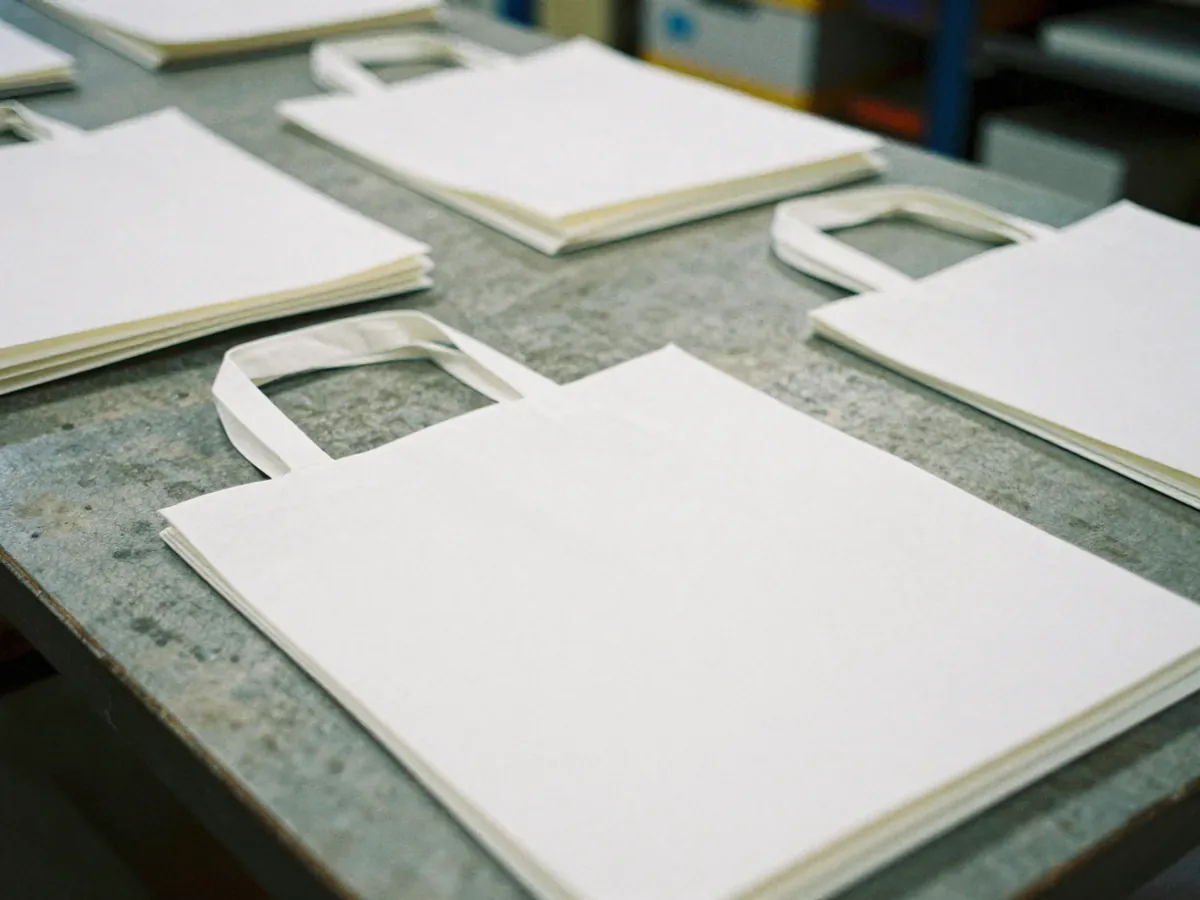
Material is not a separate decision from naming. It is the decision that makes the name legal. Paper points to carrier bag or paper carrier bag. Plastic film points to vest bag or singlet bag in most markets. Woven and non-woven polypropylene sit in an awkward middle, often called reusable bags or eco-bags depending on the region. Fabric points to tote bag or shopper bag.
The line should name the material in trade terms, not marketing terms. Canvas is a weave and a weight, not a mood. Polyester is a fibre, and 600D polyester is a fibre plus a denier. rPET is recycled PET and should be written that way if the buyer needs the recycled content story to survive a compliance check. Writing eco-friendly fabric on the material line invites a substitution argument later.
Verification starts at incoming goods. Fabric, webbing, zips and thread should be checked against the approved spec before cutting begins, which is the only moment a wrong roll can still be returned. A material line that says canvas without a weight leaves the inspector with nothing to hold the roll against. Add the weight and the check becomes mechanical.
Handle line: woven, webbing or rope changes the pull test and the price

Handles are where the bag name and the bag price quietly diverge. A canvas tote with woven handles, a canvas tote with webbing handles and a canvas tote with rope handles are three products with one name. The handle line is what separates them, and it is the line most often left to the factory to propose.
Woven handles are folded fabric, usually self-fabric, stitched along both edges. Webbing is a flat woven strip, often polypropylene or cotton, bar-tacked at the join. Rope is round, spliced or knotted through a eyelet, and it changes the hardware list. Each option pulls differently, ages differently and prices differently, and none of that shows up if the line just says handles.
The verification method is a pull test, and it belongs on the spec sheet as a requirement rather than a hope. Pull, seam strength and bar-tack should be tested on every batch, not on the first batch. A handle that passes at sample stage and fails at bulk usually failed because the bar-tack stitch count drifted, and a stitch count on the spec sheet catches that drift.
Print line: screen print, heat transfer or woven label sets the proof date

The print line decides when production can start, because nothing runs until artwork is proofed. Screen print, heat transfer and a woven label are three different clocks. Screen print needs a mesh and a colour separation. Heat transfer needs a plate and a temperature window. A woven label needs a loom setup and a lead time measured in weeks, not days.
Write the method, the number of colours, the print area in centimetres and the placement from a fixed reference point. Placement written as centred on the front is not a placement, because front depends on which way the bag is folded. A measurement from the top seam removes the argument. The same discipline applies to the label: state whether it is sewn into a seam, attached to a handle or applied as a patch.
Proofing is the checkpoint. Artwork should be approved against a physical proof, not a screen image, because screen colour and ink colour diverge. Once the proof is signed, the print line is locked and the production date becomes real. A print line without a proof date is a schedule with no anchor.
Packing line: polybag, hang tag or retail carton moves the name onto the label
Packing is where the bag stops being a product and becomes a SKU. Polybag per piece, export carton, or retail-ready packing each demand different information on the outer label. A polybag needs a size and a quantity. A hang tag needs a barcode and a price field. A retail carton needs a store allocation, and per-store packing lists turn one order into many small labelled lots.
This line is also where the consumer-facing name appears for the first time. The name printed on the hang tag or the retail carton is the name the shopper will read, and it may not be the name on the purchase order. A buyer ordering carrier bags for a grocery chain may want the shelf label to say reusable shopping bag. That is a legitimate difference, and it needs to be written down rather than assumed.
Verification at this stage is counting and photographing. Cartons should be counted and photographed before the container seals, with the label visible in the frame. A packing line that specifies retail carton without specifying the label content leaves the factory to invent one, and invented labels are expensive to reprint.
The line buyers leave blank: what the bag is called on the store shelf
The blank line is the consumer name. Purchase orders are written in trade language, and trade language rarely matches shelf language. A buyer can order non-woven carrier bags and sell them as reusable shoppers. A buyer can order canvas totes and sell them as everyday carryalls. Both are correct in their own context, and neither is written on the spec sheet unless someone adds it.
This gap causes real friction at the label printer, at the shelf-edge system and at the returns desk. If the shelf name and the order name diverge without documentation, the first person to notice is usually a store manager holding a bag that does not match the planogram. Adding one line, consumer name as it appears on shelf, costs nothing at the drafting stage.
There is also a compliance angle. Some markets regulate what can be called reusable, and the definition usually involves thickness, volume or the number of trips the bag is designed to survive. A bag sold as reusable without meeting that definition is a labelling problem, not a manufacturing problem. The consumer name line is where that risk gets caught early.
How to check a named shopping bag before the carton seals

The check begins with the name and works outward. Read line one and ask whether a stranger in the sample room could build the right bag from it alone. If the answer is no, the rest of the sheet is already compromised. Then walk the material, handle, print and packing lines in order, because each one inherits from the one above.
At the fabric rack, hold the roll against the approved spec and confirm the weight and the fibre. At the handle station, pull a finished handle and check the bar-tack stitch count against the sheet. At the print station, compare the first bag off the line to the signed proof under the same light. At packing, open one carton and read the label aloud against the consumer name line.
The final check happens before the container seals. Dimensions, handles, logo and packed quantity should be checked by hand, and cartons counted and photographed. A bag that passes every line but carries the wrong shelf name will still come back from the store, and no inspection station catches that unless the consumer name was written down in the first place.
FAQ
Is a carrier bag the same as a shopping bag?
In trade use, carrier bag is the broader term and covers paper, plastic and fabric bags made for carrying purchases. Shopping bag is the consumer term for the same object. On a spec sheet, neither word alone is precise enough, so pair it with the material.
When should a spec sheet say tote bag instead of shopper bag?
Tote bag usually signals a fabric bag with two handles and an open top, often canvas. Shopper bag signals a larger, sturdier bag with a spacious interior, sometimes in polyester or leather. The choice depends on the material and the handle construction, not on preference.
Does the bag name change the inspection checklist?
Yes. A paper carrier bag is checked for handle patch adhesion and board caliper. A canvas tote is checked for seam strength and bar-tack. The name on line one determines which checklist the inspector carries to the floor.
What does reusable mean on a shopping bag order?
It usually means the bag is designed to survive multiple trips, and some markets tie the word to thickness or volume thresholds. Write the intended trip count and the target market on the sheet so the claim can be checked against the local rule before the label prints.