
This rewrite draws on archived zipper testing notes and current moving bag spec data to separate what a test report proves from what it cannot.
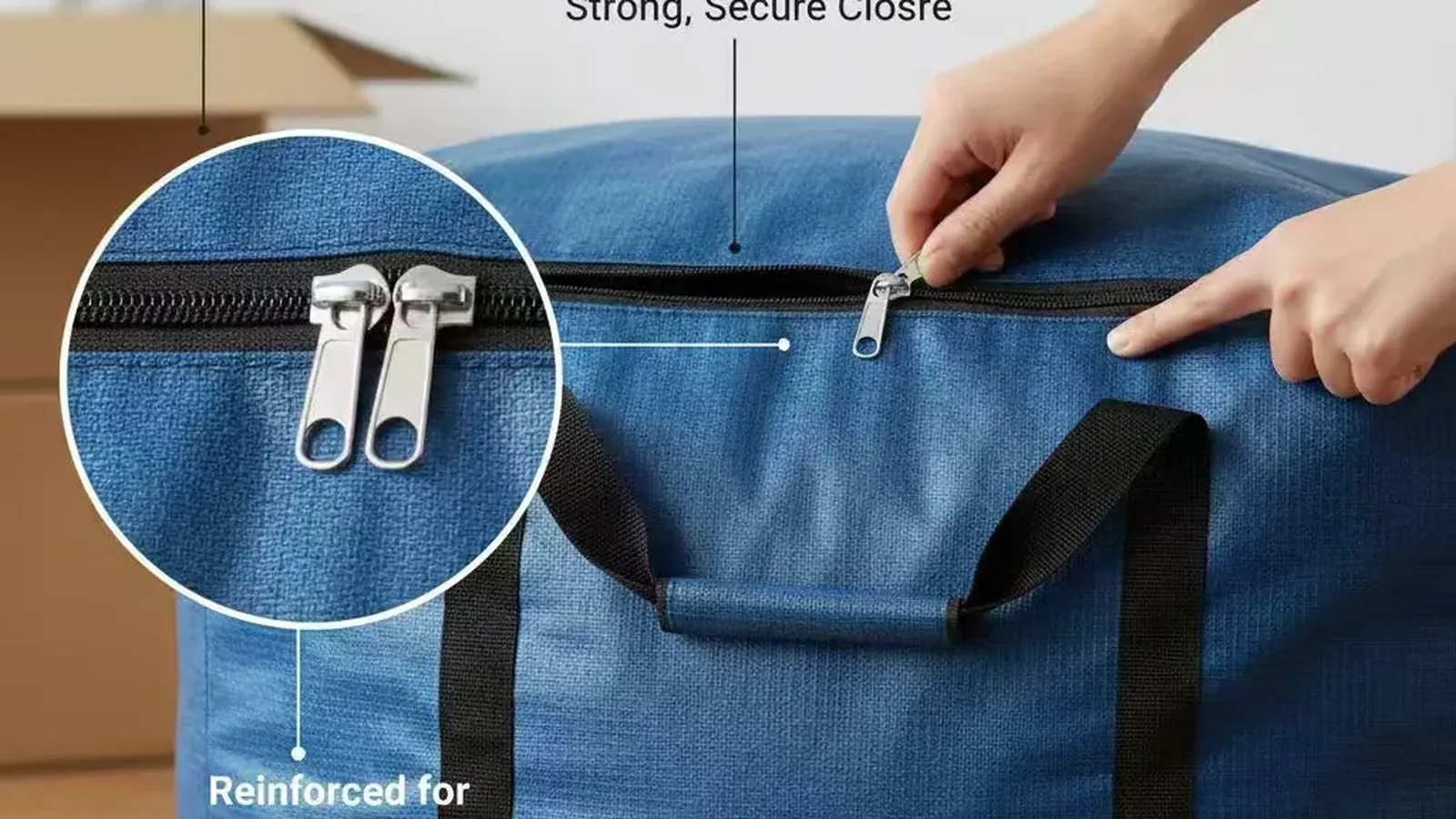
The reference photo showed a moving bag zipper closed and neat, and the buyer had circled the slider in green. She had one question attached to the image: the report says it passed, so why did the last container come back with jammed bags? The photo was taken on a sample, and the container was not.
A single test report is the most common answer a buyer accepts at the sourcing stage. It arrives as a PDF, it carries a standard number, and it gets filed. Months later, a crew on a moving job yanks a stuck slider, the slider fractures, and the bag tears open at the mouth. The report never mentioned that moment because the report was never about that bag.
The certificate that gets filed and never opened again

In most procurement folders, the zipper report sits in a subfolder named compliance, next to a business licence and a bank letter. It was issued once, often against a sample, and nobody opens it again until a claim arrives. By then the order has shipped and the cartons are in a warehouse.
The document itself is not the problem. A supplier’s certificate does not guarantee a shipment, and treating it as a shipment guarantee is where the habit goes wrong. A report describes one tested article at one moment. A purchase order describes thousands of bags made across weeks.
Why a passing report feels like enough

A lab result is easy to defend internally. It has a number, a standard, and a date. When a sourcing manager needs sign-off, a passing report closes the conversation faster than a factory visit. It also shifts responsibility: if the zipper fails later, the paper says the specification was met.
The logic holds only if the tested article and the shipped article are the same thing. In a moving bag, the zipper is not a standalone part. It is a tape, a chain, a slider, and two rows of stitching that hold all of it to a panel under load. A test can pass on the component and still miss the assembly entirely.
There is also the matter of what a standard test measures. Cycle life under controlled tension tells you how long a chain survives repeated opening. It does not tell you whether the operator on the sewing floor stretched the tape while attaching it. Both facts matter, and only one of them is in the PDF.
What the report never saw: tape drift and stitching

Most zipper failures trace back to two points: raw material shortcuts and sloppy assembly. The first is a mill decision, the second is a line decision, and the two rarely appear in the same document. A report from the mill covers the tape and chain. The stitching happens later, in a different building, sometimes in a different country.
Tape drift is the quieter problem. Colour, tooth material, and weave density can shift between reorders even when the specification is unchanged. A factory should keep a locked sample in the QC room and compare incoming tape against it. Without that comparison, a reorder can look correct on paper and feel different in the hand.
Stitching is where the highest-risk moment sits. The instant the needle pierces the tape, the assembly either holds or starts to fail. Uneven stitch length, puckering around the teeth, and a tape that rides above or below the panel edge all create the conditions for a slider to catch. None of these show up in a cycle test run on a loose chain.
Both ends of the zipper chain need a tight backstitch. A chain that is well tested but poorly anchored will separate at the end stop long before the teeth wear out. The report measures the chain. The field measures the anchor.
The batch is the unit, not the certificate
A buyer ordering moving bags is not buying one zipper. The order is a series of batches, each with its own tape lot, its own thread, its own operator shift, and its own machine settings. Quality control that ignores the batch boundary is checking the wrong thing.
This is why a batch-level test report matters more than a one-time certificate. The report should carry a date, a lot number, and the measured pull force for that lot. If a supplier cannot produce a report tied to the specific batch that filled the carton, the certificate in the folder describes something else.
The same logic applies to the gauge used for slider retention checks. A digital pull force gauge must be calibrated, and the calibration log should be current. An uncalibrated gauge produces a number, and a number without calibration is a guess with a decimal point.
Reading a zipper on the sewing floor

Walk to the line and the questions change. Paperwork tells you what was tested. The floor tells you what is being made. On a heavy moving bag, the zipper should sit flush with the panel edge, with no more than a small deviation. If the operator is rushing, the tape drifts and the slider will catch on fabric instead of gliding on teeth.
Stitch length should be uniform along the whole opening. Puckering around the teeth means the tape is being stretched as it is sewn, and a stretched tape will misalign once the bag is loaded. Run a finger along the closed zipper and feel for a catch at the midpoint. A catch there is alignment drift, the kind of defect that passes a quick visual check and fails on the first move.
Slider orientation is the other easy tell. The slider body should sit fully against the top stop, not hang loose. A loose slider is a retention problem waiting for a lateral pull, and lateral pull is exactly what a loaded bag produces when it shifts in a truck.
A short bench check a buyer can run

No lab is needed for a first read on a zipper. Take a finished bag, load it to a realistic weight, and zip it closed under moderate lateral tension. Repeat the cycle steadily and watch for the first tooth skip, tape tear, or slider separation. A zipper that fails within fifty quick cycles will not survive a single move job.
Then measure retention at three points along the chain rather than one. A weak spot near an end is common and a single midpoint reading will miss it. If any point reads low on the gauge, hold the batch instead of shipping it and ask for the lot record.
Finally, compare the tape on the bench against the locked sample. Colour, tooth profile, and weave density should match. A visible difference is a material drift signal, and material drift is one of the two root causes behind most field failures.
What to write into the next purchase order
The purchase order is where a buyer converts a preference into a requirement. Ask for a batch-level test report with the lot number and the measured pull force, not a generic certificate. Ask for the gauge calibration log alongside it. Ask that incoming tape be checked against a locked sample held in the QC room.
Add the in-process rhythm to the order terms. Zipper checks should run at the start of each shift and after any tooling change, with random samples pulled for cycle testing at a defined interval tied to production cadence. A factory that checks only at final inspection is checking too late to correct anything.
The four checkpoints already used on moving bag orders give the structure: incoming material, seams and zip, finished bag, and final count. The zipper lives in the second checkpoint, and that is where the batch record should be built. A certificate proves a sample passed. A batch record proves the bags in the carton were made the same way.
FAQ
Can I judge a moving bag zipper by looking at it?
Visual inspection catches some defects and misses others. It can show a loose slider, a puckered tape, or a chain that sits off the panel edge. It cannot show tooth interlock strength or slider retention under load. Pair the visual check with a pull test or a short cycle run before accepting a batch.
How often should zippers be checked during bulk production?
Check at the start of each shift and after any tooling change, since both events reset the conditions on the line. Pull random samples for cycle testing at a regular interval tied to output rather than to the calendar. Frequency should follow the production cadence, not the final inspection date.
What should I ask for besides a test certificate?
Ask for the batch-level report with a date and lot number, the calibration log for the pull force gauge, and evidence that incoming tape was compared against a locked sample. Ask how often in-process checks run and who signs them. Those records show whether the certificate describes the shipment or only a sample.