Based on the original TIIOCTI article on drawstring bag names, cord hardware and handle options, reorganised around the naming mistakes buyers make at sampling.
Three fabric swatches sat on the sample room table for four days: natural jute, closed canvas, and a black canvas body with black drawstrings. The buyer had labelled the request "cinch sack" in the subject line, and the sample room had built a plain cord bag with no handles at all. The handles she wanted were never in the conversation, because the name she used did not contain them.
That gap between a name and a structure is where a surprising number of bulk orders start to drift. A cinch sack, a drawstring bag, a gym sack, and a promotional pouch all describe roughly the same family of bags, and none of those words tells a factory whether short carry handles belong on the body. The buyer in that story had a clear picture in her head. The name she typed did not carry it.
The Shortcut Most Buyers Take at the Sample Stage

Most sourcing starts with a phrase, not a drawing. A buyer writes "cinch sack, 500 pieces, logo on front" and attaches a reference photo from a past event. The supplier reads the phrase, matches it to the closest standard block in the sample room, and sends back something that looks right in a thumbnail.
The shortcut works because the bag family is genuinely familiar. Pull cords, a gathered top, a soft body: these features repeat across gym sacks, giveaway bags, and retail pouches. A buyer who has ordered them before trusts the pattern and skips the part where the carrying method gets written down.
What gets skipped is small on paper and large in production. Short handles change the panel layout, the stitching sequence, and the point where the cord exits the body. A sample built from a name alone can miss all three and still photograph well enough to approve.
Why the Shortcut Feels Safe: One Bag, Three Names
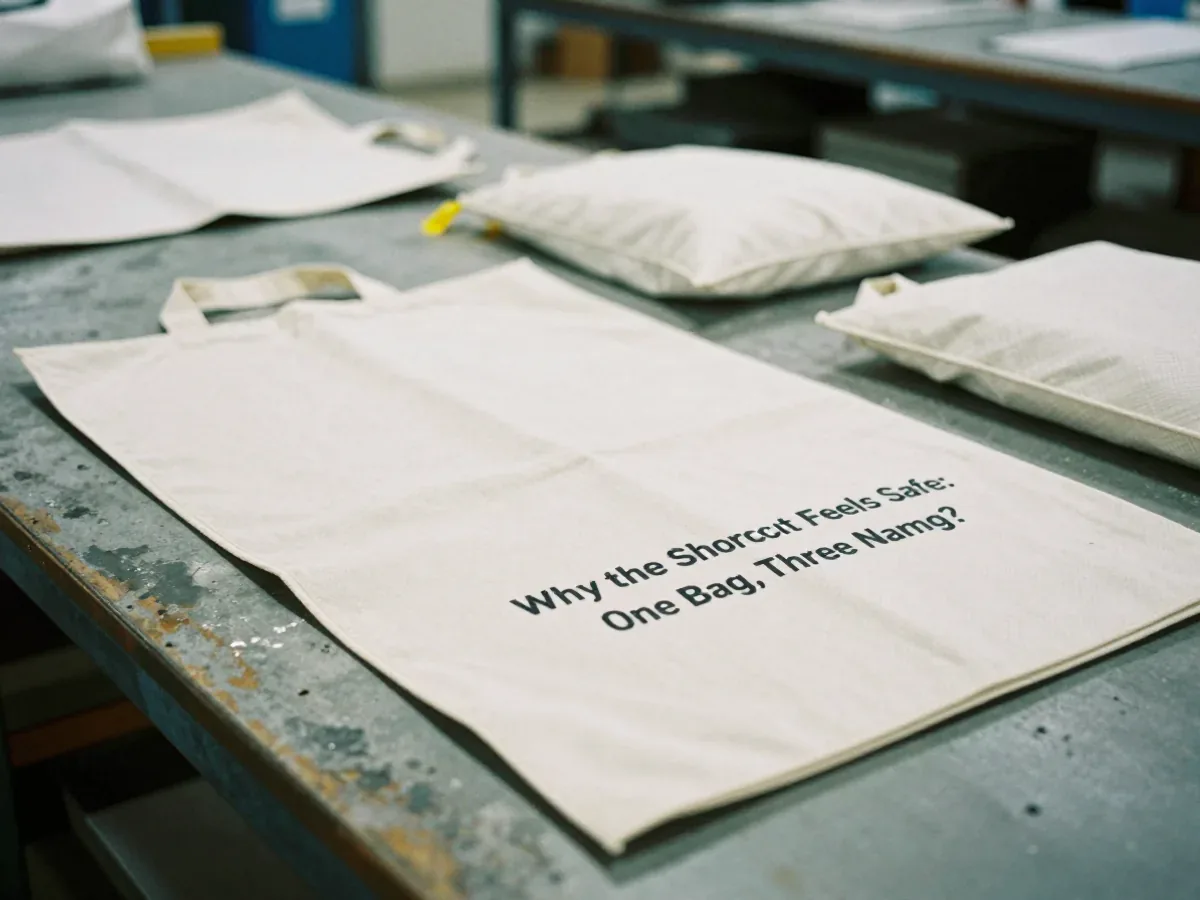
The naming confusion is not the buyer's fault. Pull string bags are commonly referred to as drawstring bags, cinch sacks, or gym sacks, and the three terms travel between regions without much discipline. A US buyer might search "cinch bag" while a European partner says "drawstring pouch" for a similar object.
Regional vocabulary makes the problem worse in a specific way. Each term carries a mental image, and those images differ. "Gym sack" suggests a single cord strap over the shoulder. "Pouch" suggests a small gift bag with no handles. "Cinch sack" sits somewhere between the two and can mean either.
A buyer who writes one of those words and attaches a photo assumes the photo closes the gap. In practice, the written line is what gets copied into the sample request, and the photo becomes a mood reference. The sample room builds to the words.
Where the Name Stops Matching the Bag
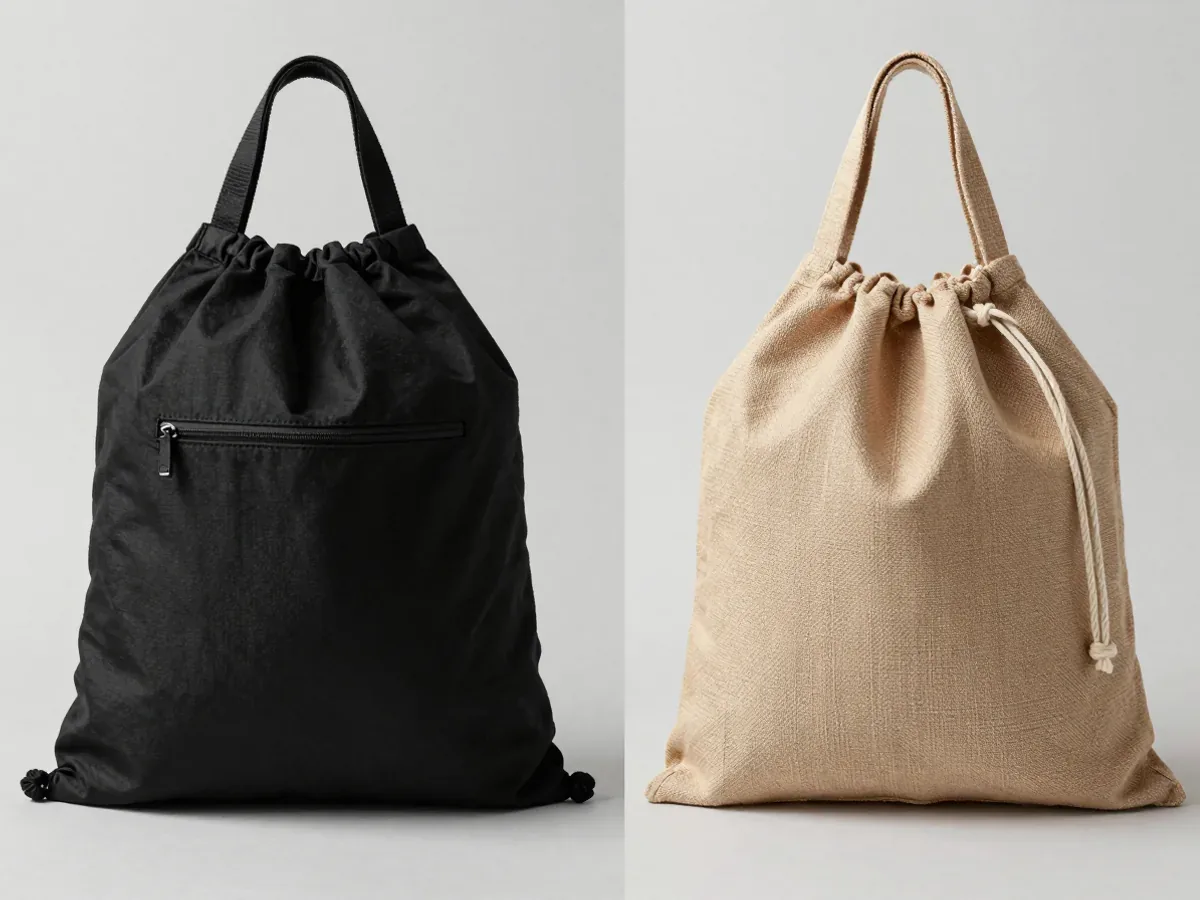
A drawstring bag with handles is a hybrid design that combines portability with convenience, offering both pull cords and short carry handles. That combination is the whole point of the product, and it is exactly what the word "cinch sack" fails to specify.
Take the black canvas version with a front zip pocket and adjustable cord straps. The cords carry the load over the shoulder, the zip pocket handles small items, and the body stays soft enough to fold. Add two short handles and the bag gains a second carrying mode: grab and go, the way a shopper carries a basket.
Now compare a plain natural jute pouch with a single drawstring closure. Same family, same cord-and-eyelet logic, completely different use case. One is a giveaway that doubles as gift packaging. The other is a reusable carry bag that a customer keeps in the car. The name on the purchase order can be identical for both.
Handles and Cords Are Two Different Decisions

Handles and cords do different work, and treating them as one feature is where specifications collapse. The cord is the closure and often the shoulder strap. The handle is a fixed grab point sewn to the body. A bag can have either, both, or neither.
Short handles change how the bag is carried, which changes the panel structure. A handle needs an anchor point with enough reinforcement to survive a loaded bag. On a soft drawstring body, that anchor sits close to the cord channel, and the two stitch lines compete for the same few centimetres of fabric.
Cord choice runs on a separate track. Drawstrings vary in shape, material, and locking style, and the common types include flat, round, elastic, and locking cords. Eyelets and plastic cord locks are the hardware that makes the closure work, and a range of both is standard in most sample rooms.
Colour matching ties the two together. Cords are matched to handle colours within the same order, which means a late change to the handle colour can pull the cord spec with it. Buyers who treat handles as a decoration and cords as a component discover this at the worst moment.
What the Wrong Label Costs in a Bulk Run
The cost of a mislabelled bag rarely appears as a single line. It spreads across three places, and only one of them shows up on the invoice.
The first is the sample cycle. A sample built to the wrong structure gets rejected, rebuilt, and re-approved, and each round adds days to a calendar that was already tight. The second is the bulk run itself. If the handle anchor was never specified, the sewing floor chooses a default, and the default may not survive a loaded bag through a season of use.
The third cost is quieter. A bag that arrives without the handles the buyer pictured gets used differently by the end customer. It becomes a shoulder sack instead of a grab bag, and the brand experience shifts with it. None of these costs are visible in a unit price comparison, which is why the naming shortcut survives.
Spec by Structure, Not by Name
The fix is to describe the bag by what it does, not what it is called. Structure language travels better than product names because it describes physical parts that a sample room can build and a QC station can check.
Start with the carrying method. Does the bag hang from cords over the shoulder, get grabbed by short handles, or both? Then name the closure: drawstring through eyelets, with or without a cord lock. Then the body material and colour, then the hardware finish, then the decoration placement.
A spec written this way reads like a parts list, and that is the point. It removes the regional vocabulary problem entirely, because "short handles plus drawstring closure" means the same thing in every factory. It also gives the sample room a checklist instead of an interpretation.
A Five-Line Check Before You Approve the Sample

Five lines on a single page will catch most of the drift before a bulk order commits.
- Carrying method: cords only, handles only, or both, with the handle drop length written in centimetres.
- Closure hardware: eyelet type, cord lock present or absent, and the cord shape (flat, round, elastic, or locking).
- Cord and handle colour: matched or contrasting, with the match confirmed in the same order.
- Body and reinforcement: material, colour, and whether the handle anchor has a backing layer.
- Decoration: placement measured from a named seam, not from the centre of the bag.
Every order passes four QC checkpoints in most production lines, and the first of those should compare the physical sample against these five lines rather than against the product name. A sample that matches the words on the page is a sample worth approving.
FAQ
Is a drawstring bag with handles the same as a cinch sack?
Not exactly. A cinch sack usually describes a cord-only bag carried over the shoulder. A drawstring bag with handles adds short grab handles to the body, which changes the panel structure and the carrying options. The two can look similar in a photo and behave differently in use.
What are the metal tips on the drawstring called?
They are called aglets. They prevent the cord from fraying and make threading easier, and decorative versions exist for branded bags. Quality aglets lift the perceived value of the whole bag, so they belong in the design conversation rather than the final checklist.
Do short handles on a drawstring bag make it a tote?
No. Bags with short handles are generally referred to as tote bags or handheld bags depending on design and use, but a tote has an open or zipped top and a structured body. A drawstring bag with handles keeps the cord closure and the soft body, so it carries like a tote without being one.
Are drawstring bags secure enough for city events?
Standard drawstring bags are less secure than zipped bags. Adding inner pockets or thicker cords improves safety, and buyers planning city events or travel should look for bags with security reinforcements rather than plain cord closures. A front zip pocket helps for small valuables.