A zone is only available if the decoration route can reach it, and custom tote bag printing is a choice of route before it is a choice of.
The spec review asks tote bag logo placement: the seam, the handle join and the label are read on a sample before the batch. Nothing about the logo had changed, only the zone, and tote bag logo placement is the decision most buyers leave until the artwork is already fixed.
The question keeps coming up because a print file carries no sense of a bag. A standard tote has a flat front panel and 7 places where a logo can sit, and each one asks something different of the ink, the handle and the artwork.
This piece walks the 7 zones, what each one suits, and the limits that decide whether a placement survives a print run rather than a proof.
Plan the zone before the artwork
The zone comes first and the artwork adjusts to it. A logo drawn to fill a centre front panel has to be redrawn for a lower front panel, and a wordmark that works above the handle will not work on a gusset.
The second planning decision is how the bag will be carried, and it decides the tote bag logo size as much as the position. A logo placed where a shoulder strap or a forearm crosses gets hidden in use, and a logo at the top of the panel is at eye level only while the bag hangs from a hand.
The 5 questions below settle the zone before a designer opens the file.
| Zone | Where it sits | What it suits | What limits it |
|---|---|---|---|
| Centre front | The middle of the flat front panel | Retail and event bags that need to be read across a room | Can read as promotional on a premium bag |
| Lower front | The lower third of the front panel | A quieter brand mark on a retail bag | Small area, and partly hidden when the bag is full |
| Upper front | Just below the handle joins | A wordmark read at eye level while carried | Handle joins interrupt the print area |
| Handle wrap | A tag or band around the handle | A premium touch on a gift style | Narrow surface, and a second part to attach |
| Side gusset | The panel that gives the bag depth | A web address or a tagline beside the main logo | A curved surface holds less detail |
| Back panel | The side against the body | Care information or a second message | Read only when the bag is set down |
| Bottom corner | A small label at the base | A mark for a brand that wants no noise | Very small, and out of sight while carried |
The gusset is the zone buyers most often overreach on. It is a good place for a short line and a poor place for a detailed illustration, because the panel curves away from the screen as it prints.
How each zone prints
A zone is only available if the decoration route can reach it, and custom tote bag printing is a choice of route before it is a choice of image. Screen printing wants a flat unobstructed surface, which is why the centre front panel is its natural home.
Heat transfer conforms to a slight curve, so a gusset or a handle tag is possible where a screen would fight the shape. Embroidery needs a stable flat area for the hoop, and a gusset or a handle wrap is generally out of reach for it. Sublimation covers a whole panel edge to edge and needs a polyester surface, so a cotton tote cannot take it.
On our bench the screen frame holds 3 inks for a typical job, and the frame height is what fixes the position on the panel. A sample is then checked for alignment against the reference before a run starts, because a print that shifts by a few millimetres in the proof will shift further on a long run.
The colour tolerance is worth measuring rather than arguing. The colour difference practice sets out how a small colour difference between swatches is calculated under a stated light, which is what turns two opinions into a number.
This practice covers the calculation, from instrumentally measured color coordinates based on daylight illumination, of color tolerances and small color differences between opaque specimens such as painted panels, plastic plaques, or textile swatches.
ASTM International, colour difference practice
A roll fed press prints a long run at one setting, and the first bag off the roll is the one that shows whether the frame is where the proof said it would be.

Where a placement goes wrong
The first mistake is a logo too close to the handle join. When the bag is loaded the fabric around that anchor bunches, and a logo within an inch of it distorts on the first heavy lift.
The second is a logo that crosses the gusset fold line. The fold is a natural boundary, and a mark that crosses it bends along the crease every time the bag opens.
The third is contrast. A dark logo on a dark panel disappears in a shop doorway, and a light logo on a light panel does the same in a photograph, so the pairing needs checking before the ink order.
4 of the 5 mistakes below cost more than a reprint. A screen cannot reproduce a fine line or a gradient, and a logo that depends on either will arrive as a blur.
The fifth is a repeated mark. A logo on the front, the gusset and the handle tag competes with itself, and the bag reads as a giveaway rather than as a brand.
A fibre name printed on a bag carries the same weight as a label line, because the terms in the labelling rule are defined rather than decorative.

Questions buyers ask about logo placement
Where do brands usually put a logo on a tote?
The centre front panel, because it offers the largest flat area and the clearest read from a distance. It is also the zone that most easily looks promotional, which is why premium brands move lower or onto a handle.
How big should a logo be on a tote bag?
Large enough to read at 2 or 3 steps and small enough to leave a margin from every seam. A mark that touches a seam or a handle join has no room for the fabric to move.
Yes, on a tag or a wrap rather than on the webbing itself. A printed handle wears at the grip and a tag keeps the mark readable while the handle does the work.
Does the bag colour change the placement?
It changes the ink choice first and the placement second. A dark bag hides a dark logo from most angles, and moving the same logo onto a lighter zone can rescue it without changing the artwork.
The position measured from a named edge, the colour against a reference under the same light, and the distance from the nearest seam. A sample approved on a screen has none of those.

What a placement decision is worth
A logo zone is a choice about how a bag is used rather than about how it looks on a mock, and a logo on a tote bag is read at the distance that use allows. A bag that is carried at the side needs a mark on the front panel, a bag that is photographed on a table needs one that survives a top down view, and a bag that travels in a stack needs a mark that can be found from above.
The 7 zones are not equal in cost or in risk. Centre front is the easiest to print and the easiest to get wrong by making it too large, while a bottom corner label is the smallest area and the most tolerant of a subtle design.
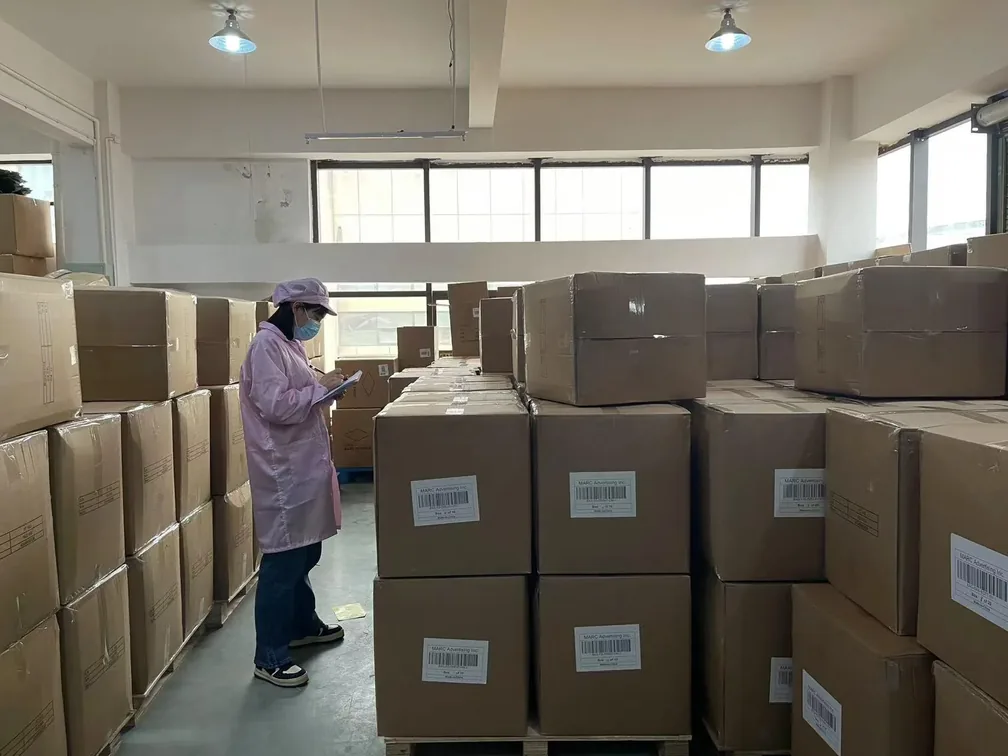
On our line the printed bag is checked against the reference by hand before a carton is packed, and the check covers the logo and the stitching on the same pass. That pass is why a lot can be compared with the first sample rather than remembered.
How to brief the next print run
4 steps will keep a logo placement from drifting between the proof and the container.
- Name the zone in words and add a measurement from a named edge, so the printer has a position rather than an impression.
- Check the artwork against the route, and redraw any fine line or gradient that the chosen decoration cannot hold.
- Approve a printed sample for position and colour under the same light the buyer will use, and keep that sample with the order.
- Keep the distance from the handle join and the gusset fold on the sheet, because those two limits are where a good logo goes wrong.
A buyer who briefs those 4 lines gets a print that can be repeated, and a printer who asks for them is a printer who has run a tote before. The Custom Printed Totes vs Stock Bags: covers what a printed order includes, and the How Do You Run Custom Tote cover what to look at when the print is the part that moved.
Related reading from the same line: Custom Printed Totes vs Stock Bags: How Do You Run Custom Tote.